
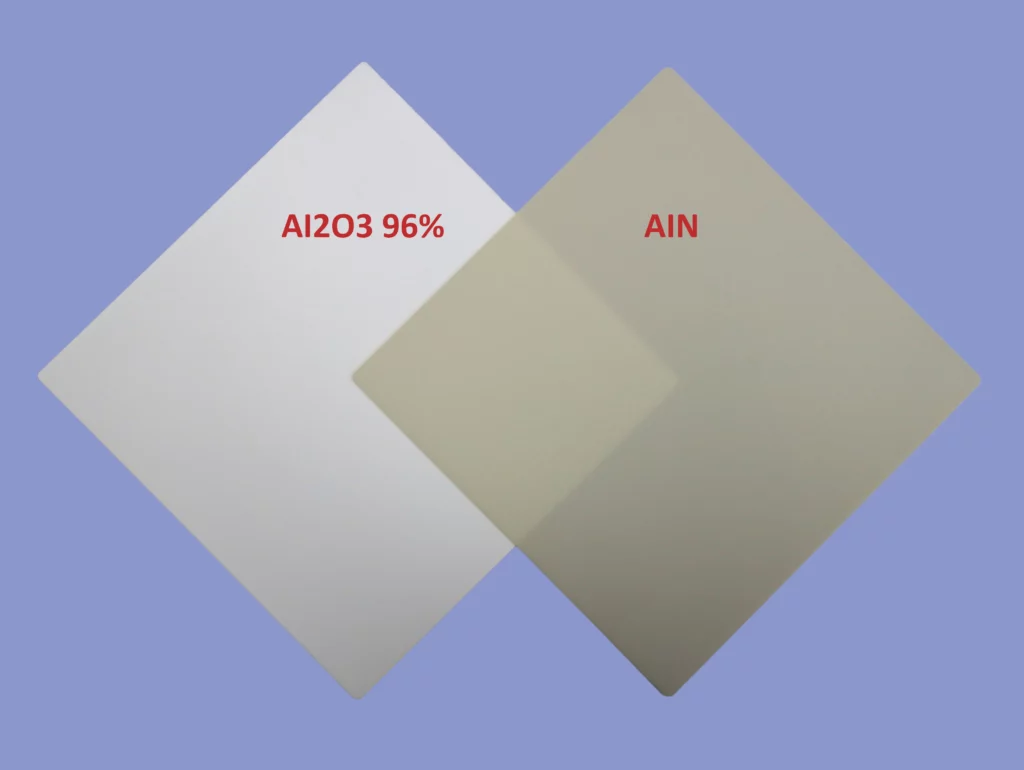
A finished ceramic PCB – also called a ceramic circuit board – does not have one intrinsic W/mK value that describes the entire assembly. Ceramic PCB thermal conductivity is primarily a property of the ceramic substrate material. The temperature rise of ceramic printed circuit boards also depends on substrate thickness, copper geometry, interfaces, mounting, heat spreading, and cooling.
Before using a datasheet value in a thermal model or RFQ, identify what was measured and what the number cannot predict.
What Does a Ceramic PCB Thermal Conductivity Value Mean?
Thermal conductivity, usually represented by k, describes how readily heat moves through a material under a temperature gradient. A value in W/mK is not a temperature, a heat-flow rating, or a guarantee that a complete PCB will stay below a particular operating temperature.
For a ceramic PCB, the reported value most often applies to bulk alumina, aluminum nitride, silicon nitride, or another ceramic substrate. It may not describe a copper-clad substrate, a patterned ceramic circuit, a multilayer construction, a soldered assembly, or the complete path from device junction to ambient air.
Material names alone are insufficient. Purity, grade, porosity, additives, and manufacturing route can affect the stated property. For an Al2O3 vs AlN PCB selection decision, use UMEC’s Al2O3 vs AlN PCB comparison separately; the task here is to decide whether the datasheet numbers are comparable.
Check What the Datasheet Value Applies To
Start with the row label, table title, footnotes, and document scope. Confirm whether the value applies to raw ceramic, a fired substrate, a metalized substrate, or a named product construction. During ceramic circuit fabrication, metallization changes the structure but does not turn bulk conductivity into a complete-board rating. For AlN ceramic PCB production, establish whether the number describes incoming ceramic or the proposed metalized build. Then record the material grade, value type, temperature, method, and document revision.
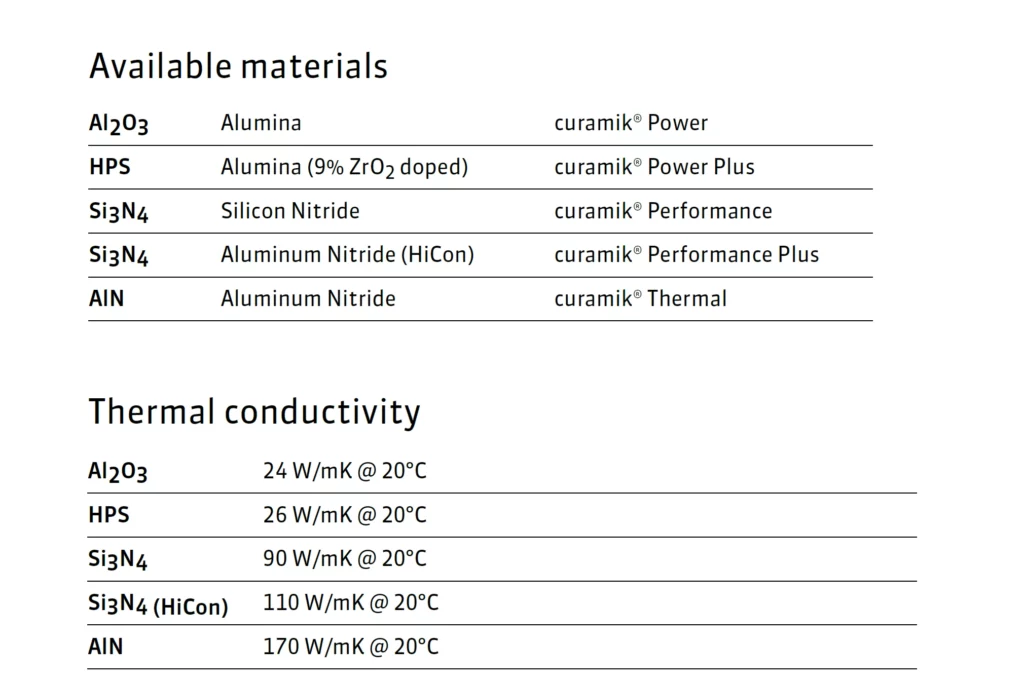
The values below show how one published datasheet lists several materials at 20 degC. They illustrate table reading, not universal specifications.
| Material entry | Listed thermal conductivity | Stated condition | What still requires confirmation |
| Al2O3 | 24 W/mK | 20 degC | Alumina grade, purity, and whether the value is typical or controlled |
| Si3N4 | 90 or 110 W/mK | 20 degC | Exact grade and why two product variants differ |
| AlN | 170 W/mK | 20 degC | Material grade, tolerance, and applicability to the ordered substrate |
Separate explicit data from assumptions. The unit and temperature are stated; grade-level tolerances, test reports, and finished-board behavior may not be. An “AlN” value alone is not an acceptance criterion.
When Are Two Ceramic PCB Thermal Conductivity Values Comparable?
Two values are directly comparable only after the following fields are normalized:
- Material identity and grade:Compare like-for-like chemistry, purity, density, and product grade.
- Test method and calculation basis:For example, ASTM E1461-13(2022) is a flash method for measuring thermal diffusivity. Thermal conductivity may then be derived from diffusivity, density, and specific heat capacity using k = alpha x rho x Cp. A reported k value without its method or inputs is harder to audit.
- Temperature:A value at 20 degC or 25 degC should not be silently used as a high-temperature property. Thermal conductivity can change with temperature, so request temperature-dependent data when the operating range materially exceeds the datasheet condition.
- Value type:“Typical,” “nominal,” “minimum,” and a stated range have different procurement meanings. A typical value is not automatically a guaranteed lower limit.
- Direction and specimen condition:Some constructions may require through-thickness versus in-plane data, as well as density, porosity, or surface-condition details.
- Unit and revision:Normalize W/mK, W/mK, or W/m-K notation and confirm that both documents use the current specification revision.
If any decisive field is missing, ask the supplier before ranking the materials or quotations. A 180 W/mK entry is not automatically superior to a 170 W/mK entry when the grade, temperature, method, or value type differs.
Why the Board Structure Still Matters
Thermal resistance connects material conductivity to a specific geometry. For ideal one-dimensional conduction through a uniform layer:
Rth = t / (k x A)
Consider a 10 mm x 10 mm heat-transfer area, a 0.635 mm substrate, and 50 W of heat. Using 170 W/mK for AlN gives a substrate-only resistance of approximately 0.037 K/W and an idealized temperature difference of about 1.9 degC. Using 24 W/mK for alumina gives approximately 0.265 K/W and about 13.2 degC.
Structure matters because this calculation covers only a uniform substrate layer. Real assemblies add patterned copper, metallization, solder or die attach, interface materials, contact resistance, heat sinks, and convection. A ceramic multilayer PCB or ceramic PCB multilayer design adds further layers and interfaces. The result checks scale; it does not guarantee device temperature.
The ceramic PCB manufacturing process matters for the same reason. DPC, DBC, LTCC, and HTCC use different conductor and layer structures; UMEC’s ceramic PCB process comparison explains those differences without turning a bulk-material value into a finished-board rating.
Questions to Ask Before Using a Datasheet Number
Use a short supplier clarification list before approving a simulation input, specification, or material substitution:
- Which material, grade, purity, and product form does the value describe?
- Is the value typical, nominal, minimum, maximum, or a controlled range?
- At what temperature and in which direction was it measured?
- Which test method, specimen condition, density, and heat-capacity inputs were used?
- Does the value apply to the proposed substrate thickness and metalized construction?
- Is a current specification, certificate, or representative test report available?
- Which thermal results must be confirmed through project-specific modeling or testing?
These questions prevent a property-table number from becoming an unsupported performance promise. They also make supplier responses easier to compare because each quotation is tied to the same technical basis.
When a ceramic PCB RFQ reaches UMEC, our engineering team does not start with the datasheet number. We first confirm which ceramic grade is specified, then ask the material supplier for two things: the test method used to obtain the value and the temperature at which it was measured – most datasheets only state a room-temperature figure. We also check whether the quoted value applies to the bare substrate or to a metalized structure, because DPC and DBC processing changes the effective thermal path. Finally, we estimate thermal resistance based on your actual board thickness and copper area, and confirm in writing which values are material inputs and which performance points require design verification or testing.
A Practical Checklist for Design Reviews and RFQs
Engineering should provide the application, heat-source size and location, expected dissipation, ambient and operating-temperature range, allowable temperature rise, mounting, cooling method, board dimensions, substrate thickness, copper construction, and drawing revision. Procurement should add quantity, delivery stage, required documentation, and whether alternatives are permitted.
Ask each ceramic PCB manufacturer to state the ceramic grade, applicable conductivity data, value type, temperature, method, and specification revision. For a ceramic PCB for RF or lighting applications, include the operating conditions that define the thermal load. If the project requires high reliability, high-temperature resistance, or low thermal expansion, state separate acceptance criteria instead of assuming conductivity proves those properties.
UMEC’s ceramic PCB fabrication capabilities include alumina and aluminum nitride options together with construction parameters. Use those capabilities as a starting point, then request project-specific confirmation. For a broader quotation package, the ceramic PCB cost guide helps align material, process, copper, geometry, finish, testing, and volume. Cost-effective ceramic PCB manufacturing begins with comparing the same controlled build.
Conclusion: Use W/mK as a Material Input, Not a Performance Guarantee
Ceramic PCB thermal conductivity is a necessary material input, but it is not a complete board or device rating. First, confirm what the number applies to. Then compare grade, test basis, temperature, direction, value type, unit, and revision. Finally, translate the material property into the actual thickness, area, layer structure, interfaces, and cooling path.
For a UMEC review, send the drawing, stack-up, ceramic preference or permitted alternatives, substrate and copper thicknesses, heat load, operating-temperature range, cooling method, quantity, and required verification. The engineering discussion can then focus on data applicability and design risk rather than an isolated datasheet number.
Perguntas frequentes
Is a higher W/mK value always better for a ceramic PCB?
No. It indicates higher material conductivity under the stated conditions, but the material must still meet electrical, mechanical, manufacturing, reliability, and cost requirements. Values also need a comparable test basis.
Why do two AlN datasheets report different conductivity values?
The grades, additives, density, porosity, test temperature, method, calculation inputs, and value type may differ. Ask both suppliers for the complete test and specification basis before judging the difference.
Can I use a room-temperature value in a high-temperature thermal model?
Only if its applicability is justified. Request temperature-dependent data or a validated engineering assumption when the operating range extends materially beyond the datasheet condition.
Does substrate thermal conductivity equal ceramic PCB thermal resistance?
No. Conductivity is a material property. Thermal resistance depends on conductivity, geometry, and the complete heat path, including interfaces, copper, mounting, and cooling.
For a project-specific fit check, request a ceramic PCB datasheet review from UMEC, including the technical package and the operating conditions the final assembly must meet.