
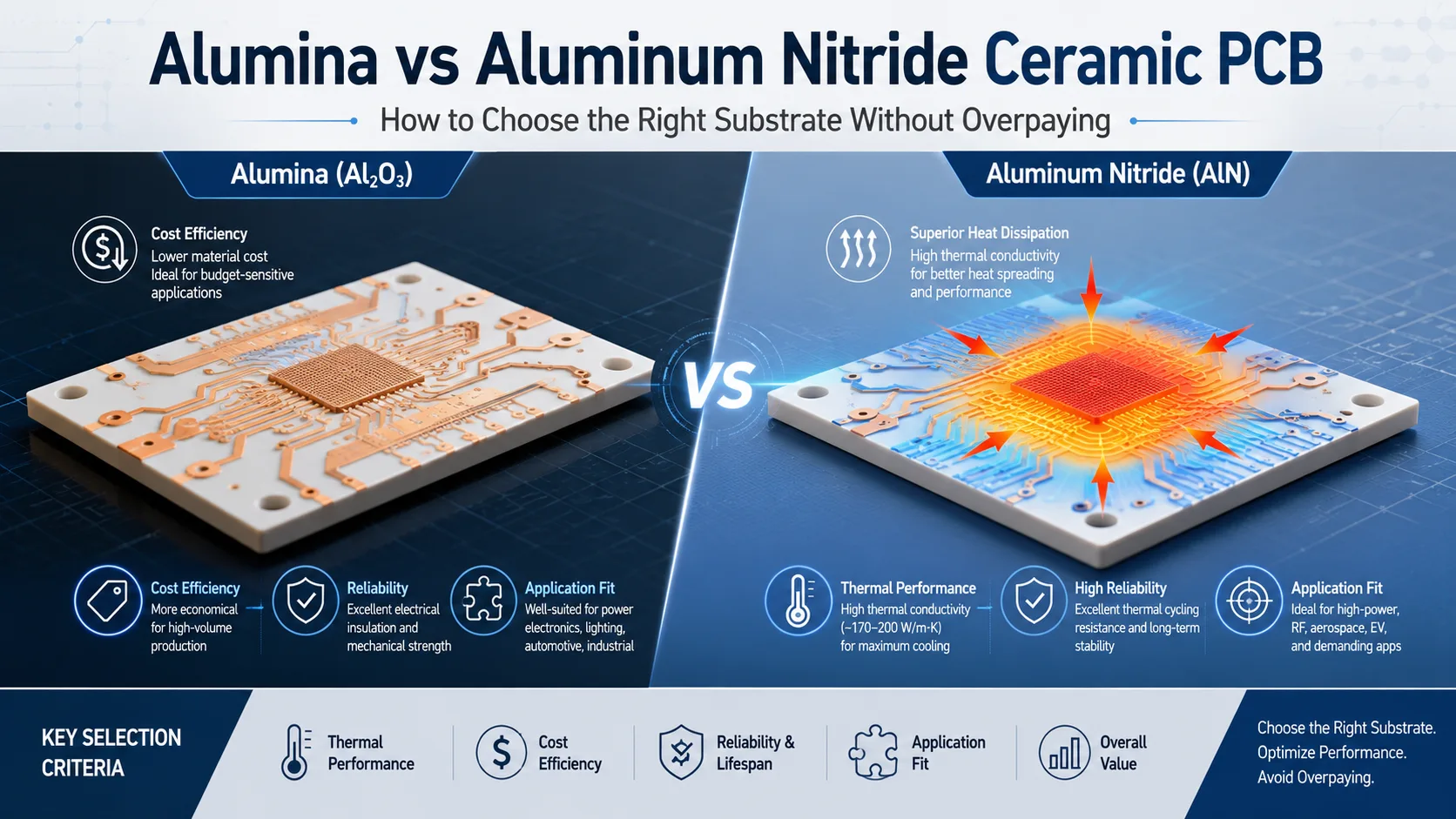
Choosing between an alumina vs aluminum nitride ceramic PCB is usually not a materials question alone. It is a decision about thermal design, reliability, cost, and sourcing. For B2B buyers, hardware engineers, RF teams, LED module manufacturers, power electronics designers, and equipment maintenance teams, the real question is simple: Will alumina ceramic PCB performance be sufficient, or does the application truly require the higher thermal capability of an aluminum nitride PCB? UMEC will tell you the answer.
A ceramic PCB substrate is often selected when FR-4 or standard metal-core PCB materials cannot meet the application’s heat resistance, thermal stability, insulation, or high-frequency requirements. Industry design resources commonly treat thermal conductivity and coefficient of thermal expansion as key selection factors for ceramic PCB designs, especially in high-density and high-power electronics.
Quick Answer: Choose Alumina for Cost Efficiency, Choose AlN for Critical Heat Dissipation
The first substrate candidate for many industrial electronics is alumina ceramic PCB. It provides electrical insulation, medium thermal conductivity, and high cost efficiency. It can be considered a good solution for cost-sensitive LED modules, sensor circuits, industrial controls, and applications, where thermal management plays its role but is not critical.
If heat dissipation, thermal cycling capability, or matching semiconductor packaging come into play, an aluminum nitride ceramic PCB, which is also known as an AlN ceramic PCB, can be used. On UMEC’s website dedicated to ceramic PCBs, alumina circuit boards are described as cost-effective and widespread. In contrast, aluminum nitride circuit boards are considered better for their high thermal conductivity and silicon-matching thermal expansion.
Here is the rule to remember: always start with the heat load, not the material name. If your thermal simulation or experimental data show sufficient safety margins regarding the use of an Al2O3 ceramic substrate, the choice should be made in favor of alumina. Otherwise, the AlN ceramic substrate can pay off due to the high-power chip and small cooling spaces in the design.
Alumina vs Aluminum Nitride Ceramic PCB: Key Properties That Affect Substrate Selection
The key difference between Al2O3 and AlN ceramic PCB lies in how each material handles heat, stress, cost, and manufacturability. The right choice depends on operating temperature, power density, board size, copper thickness, assembly method, cooling structure, and expected lifetime.
| Selection Factor | Alumina Ceramic PCB | Aluminum Nitride Ceramic PCB |
| Main advantage | Cost-effective ceramic substrate | Higher thermal performance |
| Best-fit applications | Moderate-power LED, sensors, industrial electronics | High-power LED, RF power, SiC/GaN modules, laser devices |
| Thermal decision | Suitable when the heat margin is sufficient | Better when heat must move quickly from the chip to the heat sink |
| Cost position | Usually lower | Usually higher |
| Procurement risk | Overusing it in high-heat designs may cause thermal problems | Using it where alumina is enough may increase the cost unnecessarily |
Thermal Conductivity and Heat Dissipation Limits
Thermal conductivity is usually the primary justification for choosing an alumina PCB (Al₂O₃ 96%: 20-24 W/m·K; Al₂O₃ 99.6%: 29-35 W/m·K) over an AlN PCB (170-200 W/m·K). When there is sufficient margin between component power consumption, PCB area, copper configuration, and heat sink, alumina might function just fine. But the situation changes when the design has high heat flux, operates continuously at high temperatures, experiences high ambient temperatures, or has a low PCB area for heat spread.
When quick heat transfer from the die, LED chip, RF transistor, or power semiconductor is required, AlN comes into play. This scenario is common in high-power LED array applications, laser diode modules, RF power amplifiers, compact power converters, and SiC or GaN power electronics. Ceramic PCB materials offered by UMEC include Al₂O₃ 96%, Al₂O₃ 99%, AlN, SIN, SIC, ZrO₂, and ZTR, each with a specified thermal conductivity. The material choice is an actual RFQ item, not a general preference.
CTE Matching, Thermal Cycling, and Chip-Level Reliability
However, thermal conductivity alone is not the only factor of interest. The coefficient of thermal expansion (CTE) determines the rate of expansion and contraction of the substrate during heating and cooling. Thermal stresses arise when the ceramic substrate, copper, solder joints, and semiconductor package undergo expansion and contraction at varying rates.
This is important in applications such as power modules, RF packaging, COB LED assemblies, lasers, automotive electronics, and machinery operating in environments with rapid temperature changes. When the design involves repeated startup sequences, significant changes in the junction temperature, or direct bonding of chips near the ceramic substrate, the coefficient of thermal expansion becomes just as important as heat transfer. AlN becomes an important choice where there is a need to minimize thermal stress, solder joint fatigue, cracks, or delamination.
Cost, Availability, Manufacturability, and Lead Time
AlN ceramic PCB is usually selected for performance rather than the lowest board price. Its cost may vary by material grade, board size, thickness, copper process, surface finish, yield, tolerance requirements, and order quantity. Alumina is often easier to justify when the application does not need the extra thermal performance. The choice of substrate may also depend on the available manufacturing process. DBC (Direct Bonded Copper) is commonly used for power modules on both alumina and AlN, while DPC (Direct Plated Copper) allows finer line resolution for LED and RF applications.
The lowest PCB unit price is not always the lowest system cost. If AlN reduces the need for larger heat sinks, active cooling, thermal interface materials, or field repairs, it may be commercially reasonable. If those savings do not apply, alumina may help avoid overpaying.
When Alumina Ceramic PCB Is the Better Choice
Alumina Ceramic PCB is the right option when you need ceramic insulation, stability, and better thermal performance than ordinary laminated substrates, but don’t need the best thermal conductivity.
This kind of PCB serves most budget-conscious B2B markets, including standard LED modules, industrial sensor boards, heater control circuits, power driver boards with average thermal load, and cost-sensitive products. However, the purchasing department must always check the material type, substrate thickness, copper foil thickness, surface finish, operating conditions, and thermal loads before ordering alumina.
This PCB type is not recommended for designs that have insufficient thermal margin. Red flags include repeated overheating after mounting, discoloration around high-power components, premature lumen depreciation in LEDs, power module malfunction, RF output instability, and thermal analysis results close to the device threshold. Here, the next step would be thermal analysis, not another order of the same substrate.
When Aluminum Nitride Ceramic PCB Is Worth the Extra Cost
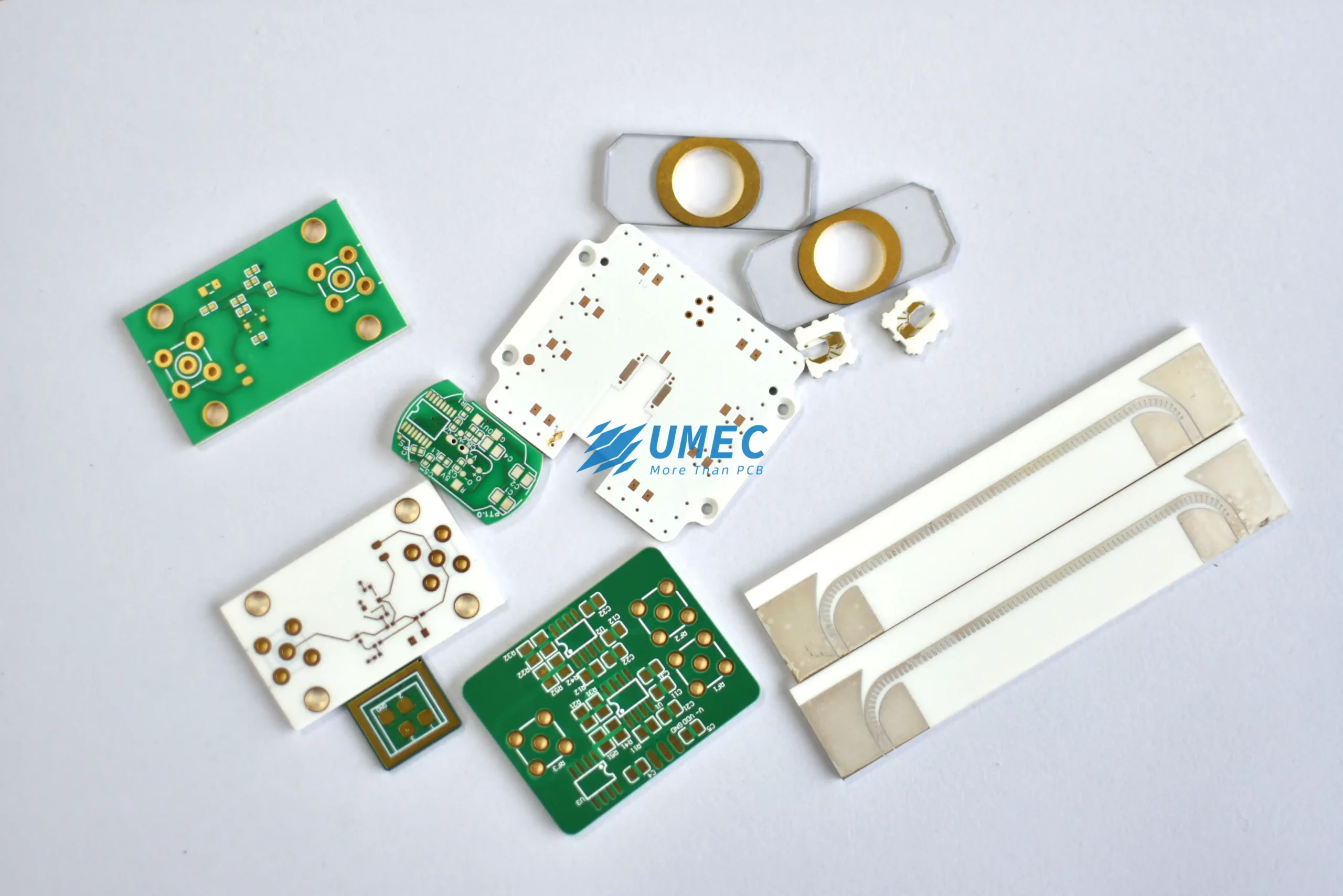
Aluminum nitride PCB is worth evaluating when failure risk or system cost is driven by heat. It is especially relevant for high-power LED arrays, laser diode modules, RF power amplifiers, 5G or microwave front-end modules, SiC/GaN power devices, EV power modules, compact converters, and high-current electronics where board area is limited.
AlN is also useful when the design needs a closer thermal expansion match with semiconductor chips. That can help reduce mechanical stress during thermal cycling, especially in compact assemblies where the substrate is part of the thermal path and package reliability strategy.
However, AlN is not automatically the right choice. If the load is low, the heat sink is oversized, the operating duty cycle is short, or the project is extremely price-sensitive, AlN may not create enough value. Buyers should request a supplier review based on application data rather than asking for “the best ceramic PCB material.”
How to Avoid Overpaying for Ceramic PCB Substrates
The best way to avoid overpaying is to define the thermal requirement before choosing the substrate. Engineers should estimate heat generation, target junction or case temperature, ambient temperature, duty cycle, cooling method, board size, and allowable temperature rise. Procurement teams should ask whether alumina can meet the requirement with a safe margin before moving to AlN.
A useful purchasing question is: “What problem is AlN solving in this design?” If the answer is lower junction temperature, smaller module size, improved thermal cycling reliability, or reduced cooling hardware, the higher material cost may be justified. If the answer is only “better performance,” the design may need more review.
For sourcing, a custom ceramic PCB quote should include material, board thickness, copper thickness, layer count, minimum line and space, hole size, surface finish, quantity, drawings or Gerber files, and operating conditions. This allows the supplier to check manufacturability and quote the actual build, not just a material name.
RFQ Checklist and Supplier Selection for Alumina or AlN Ceramic PCBs
A qualified supplier should help buyers connect application requirements to material selection. For alumina vs. aluminum nitride ceramic PCB projects, the supplier should be able to discuss thermal requirements, substrate options, copper processing, surface finishes, tolerances, testing requirements, and production quantities.
UMEC provides ceramic PCB manufacturing for thermal management, covering ceramic circuit boards such as alumina and aluminum nitride, with stated manufacturing capability parameters for materials, dimensions, line/space, copper thickness, testing methods, and surface treatments. For buyers comparing custom PCB manufacturers and PCBA manufacturing partners, this matters because the right ceramic substrate decision must align with the full build requirements, not just the base material.
UMEC’s company information also describes turnkey manufacturing services, including PCB design, fabrication, assembly, and testing, delivered through its self-owned factories and a vetted manufacturing network in China. Buyers reviewing a supplier’s background can learn more through About UMEC before sending project files.
Before requesting pricing, prepare the application type, Gerber files, target quantity, substrate preference, thermal requirement, board thickness, copper thickness, surface finish, and any failure symptoms from an existing board. For active sourcing or replacement projects, the next step is to contact UMEC with drawings, material expectations, operating conditions, and target production volume.
Conclusion
Alumina ceramic PCB is usually the practical starting point when cost efficiency matters and thermal requirements are moderate. Aluminum nitride ceramic PCB is the stronger choice when heat dissipation, compact power density, chip-level reliability, or CTE matching drives the design risk. The right decision should be based on thermal load, reliability margin, system cost, and manufacturability, not on material reputation alone.
For a ceramic PCB quote, submit the Gerber files, substrate material preference, board size, thickness, copper requirement, surface finish, quantity, application, operating environment, and any overheating or reliability concerns. This gives the supplier enough information to recommend alumina, AlN, or another ceramic PCB material without unnecessary overdesign. Visit UMEC to request a ceramic PCB quote, or send your Gerber files for a response within 24 hours.
FAQs
Q1: How do I know whether alumina or aluminum nitride ceramic PCB is right for my application?
A: Start with the thermal requirement. If alumina can keep the device within the target temperature range with enough margin, it may be the more cost-effective option. If the design has high power density, limited cooling space, repeated thermal cycling, or chip-level stress concerns, an aluminum nitride ceramic PCB should be evaluated.
Q2: Is an aluminum nitride PCB always better than an alumina PCB?
A: No. Aluminum nitride typically offers better thermal performance, but alumina may be the better choice when the application does not require that extra heat dissipation. In cost-sensitive industrial electronics, sensors, and moderate-power LED modules, alumina ceramic PCB can be a practical solution.
Q3: Why is the aluminum nitride ceramic PCB more expensive?
A: AlN PCB cost may be higher because of material cost, processing difficulty, yield control, tolerance requirements, copper process, substrate thickness, and order quantity. The added cost should be compared with system-level benefits such as reduced cooling hardware, smaller module size, or improved reliability.
Q4: Can alumina ceramic PCB be used for high-power LED applications?
A: Alumina can be used in some LED applications when the power level and thermal path are within safe limits. For dense high-power LED arrays, compact lighting modules, laser-related designs, or continuous high-temperature operation, an AlN ceramic substrate may provide a better thermal safety margin.
Q5: What information should be included in a ceramic PCB RFQ?
A: A useful RFQ should include Gerber files, material choice, board size, substrate thickness, copper thickness, surface finish, layer count, minimum line and space, hole requirements, quantity, application, operating temperature, cooling method, and any target thermal performance or reliability requirement.