

PCB material shortages in 2026 affect more than just unit prices. For OEM buyers, engineers, and equipment manufacturers, the urgent question is whether the specified copper-clad laminate (CCL) and prepreg will be available when fabrication starts. A quote may be commercially acceptable but operationally risky if material is not reserved, the stackup depends on one grade, or an alternative requires customer approval. The response is to identify critical requirements early, confirm what the supplier can allocate, and define an approval path before production. UMEC provides PCB manufacturing and engineering support, but availability must be verified for each RFQ.
What Changed in the PCB Material Market in 2026?
Confirmed Price Revisions—and What the Percentages Mean
Official 2026 supplier notices show that CCL and prepreg revisions are real, but they do not apply uniformly. One April notice treated general multilayer materials, low-transmission-loss materials, CCL, and prepreg as separate categories with different adjustment ranges and an effective date. A public laminate increase is not the same as the final increase on a fabricated PCB. Board size, layer count, material utilization, copper construction, process complexity, and existing inventory all affect the quotation. Buyers must ask which grade changed, when the cost took effect, and whether the order uses old, allocated, or newly purchased stock.
UMEC’s 2026 CCL price increase update provides market-event context, but a purchasing decision should be based on the stackup and current RFQ date. A supplier announcement may justify reviewing a quote; it does not justify applying one percentage to every board.
Why Price Changes and Lead Times Do Not Move Together
A common FR-4 grade remains available at a higher price, while an uncommon thickness or low-loss construction has a longer replenishment cycle. Material shown in a distributor system may also be shared inventory rather than project-reserved stock.
Before accepting a delivery date, distinguish physically available stock, inbound material with a confirmed schedule, unreserved supplier allocation, and buy-to-order material. Quote validity should also be separated from reservation validity. A price can remain valid while the material remains unreserved.
Why Are CCL and Prepreg Lead Times Rising?
Raw-Material and Production Constraints
CCL and prepreg depend on resin systems, reinforcement materials, copper foil, impregnation or coating, curing, inspection, and logistics. A disruption at any stage may raise cost; only some disruptions create a shortage. Higher energy or freight costs will change price without stopping supply; a constrained reinforcement style, resin formulation, copper profile, or line can delay a specified construction.
Buyers must request an explanation tied to the quoted material rather than accept a general statement that “raw materials are increasing.” Useful evidence includes the exact grade, required core and prepreg constructions, available quantity, replenishment date, and whether material has been assigned to the order.
Why Specialty and Single-Source Constructions Carry More Risk
High-speed, low-loss, RF, and certain high-reliability builds often have narrow substitution windows. The design usually depends on a specific dielectric thickness, Dk/Df range, copper roughness, resin behavior, or qualified construction. UMEC’s material information notes that some advanced materials or builds may be single-source, making early review important.
The same logic applies to HDI PCB builds. Sequential lamination, thin dielectric layers, microvias, and controlled impedance make material and fabrication interdependent. A nominally similar laminate may change pressed thickness, resin flow, impedance, or microvia reliability. UMEC lists high-Tg, high-speed, and high-frequency materials among its HDI categories, but a grade’s suitability depends on the project construction.
Which PCB Orders Face the Highest Material Risk?
| PCB construction | Main material risk | Substitution flexibility | Buyer action |
|---|---|---|---|
| Standard multilayer | FR-4 grade, core thickness, prepreg | Moderate | Confirm approved grades and reservation |
| HDI | Thin cores and sequential lamination | Low to moderate | Freeze the stackup before fabrication |
| High-speed digital | Dk/Df, copper profile, loss target | Low | Recalculate impedance and loss |
| RF or hybrid | Exact laminate, bondply, mixed processing | Low | Confirm grade, thickness, and process history |
| Heavy-copper multilayer | Base material plus copper capacity | Moderate | Confirm material and production slot |
For multilayer PCB manufacturing, warning signs include a customer-nominated brand, an unusual core thickness, tightly controlled impedance, a high layer count, low-loss material, a hybrid construction, or a fixed launch date with no approval window. Prototype and volume orders need different planning. A prototype still requires a full sheet or special purchase; a production reservation makes late design changes more costly.
What Should PCB Buyers Do Before Placing an Order?
Separate Performance-Critical Requirements from Brand Preferences
A drawing should preserve requirements essential to electrical performance, thermal reliability, safety, or customer qualification. Other requirements may be expressed as an approved range or vendor list, giving the PCB supplier room to manage supply without changing design intent.
A brand-specific material is appropriate when required by a validated signal-integrity model, regulatory file, customer approval, or reliability program. A performance-based specification suits standard industrial boards when Tg, Td, Dk/Df, CTE, CAF resistance, CTI, thickness, copper type, and the IPC specification are clear. IPC-4101 covers laminate and prepreg base materials for rigid and multilayer printed boards through specification sheets.
An alternative is a candidate subject to engineering review and customer approval, not an automatic drop-in replacement.
Confirm Availability, Allocation, and Change-Control Terms
A useful PCB material availability check should answer more than “yes” or “no.” Procurement must confirm the brand and grade, core and prepreg constructions, available quantity, material status, replenishment date, quote validity, reservation period, minimum purchase requirement, and the consequences of any changes to quantity.
Confirm whether another approved grade may be proposed and whether written approval is required. The change process should identify who reviews the datasheet, recalculates the stackup, defines testing, and records the final material.
Forecasts and split deliveries can reduce risk, but they do not lock in material while design, quantity, or compliance requirements remain unstable. For a time-critical program, freeze prototype construction, reserve materials, and release production quantities upon approval.
How to evaluate approved alternatives?
Compare the Material Against the Application, Not One Number
Higher Tg alone does not make a laminate suitable. The review needs to compare the properties that govern the application: thermal limits, Z-axis expansion, electrical loss, dielectric behavior, moisture response, CAF performance, CTI, flammability status, copper foil availability, thickness availability, and processing window. Data should use compatible test methods and frequencies.
UMEC publishes a qualified PCB material list covering standard FR-4, high-Tg, mid-loss, low-loss, and advanced material families. That list is a starting point, not blanket approval. A candidate must still be checked against the drawing, stackup, end use, and documentation requirements.
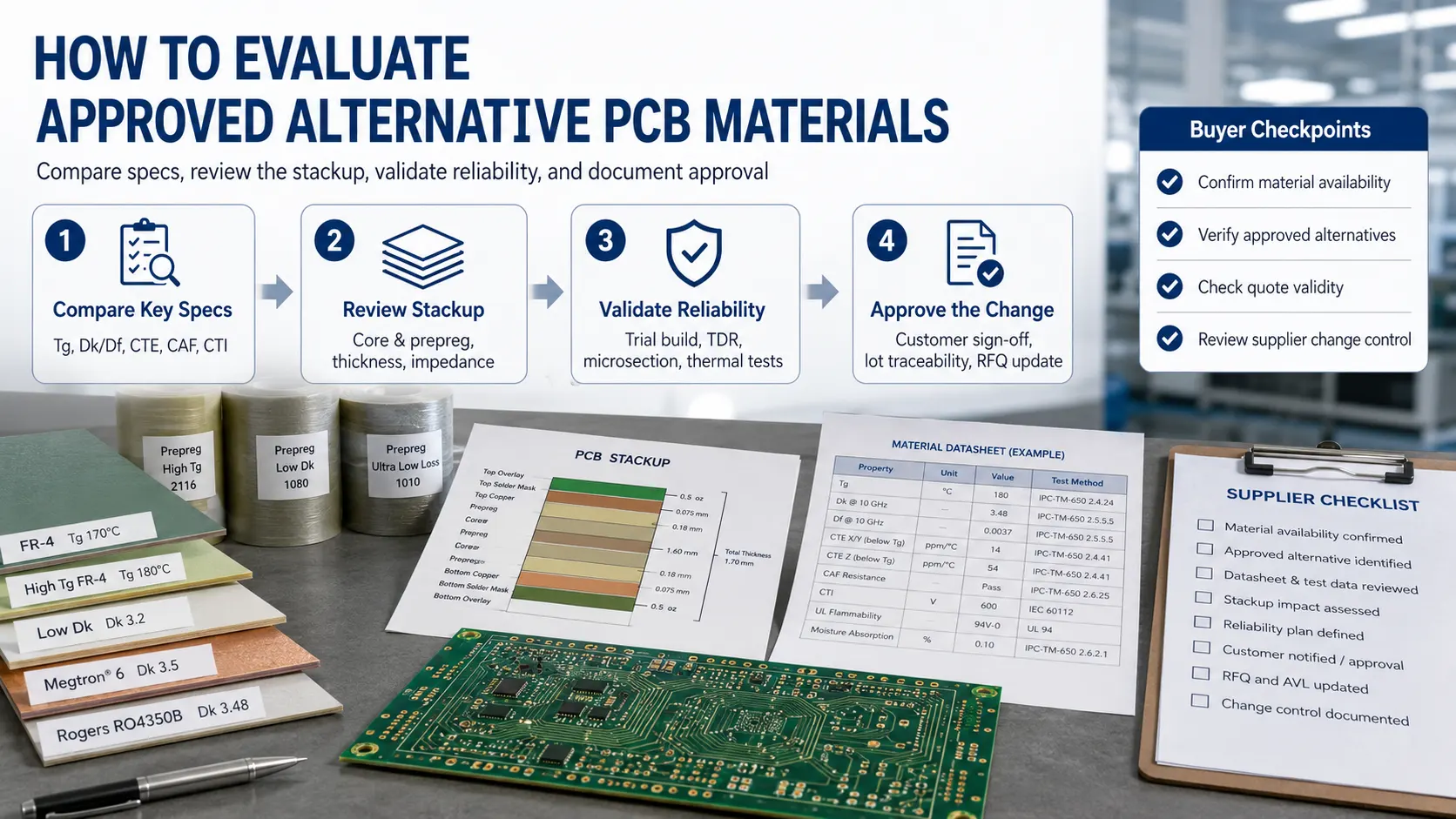
Validate the Stackup and Reliability Before Release
After datasheet review, the supplier must recalculate dielectric thickness and impedance, assess processing behavior, and decide whether a trial build is necessary. High-speed, RF, HDI, automotive, medical, aerospace, or qualified products generally require tighter control.
A controlled sequence includes stackup review, trial build, dimensional inspection, microsectioning, electrical testing, impedance measurement, thermal stress evaluation, and limited production release. Substitution should not proceed when the drawing prohibits it, comparable data is unavailable, compliance coverage is missing, or the revised construction cannot meet electrical or reliability requirements.
How to Choose a PCB Supplier During a Material Shortage
A capable supplier explains material status, not repeat a shortage claim. Verify whether the material is approved, whether stock is physical or supplier-confirmed, whether the lot can be reserved, and how it is traced. The supplier should also have a process for second-source review, engineering change notification, stackup recalculation, and customer approval.
UMEC states that its base materials follow a documented qualification procedure and are reviewed through preferred-supplier-list factories. Its scope includes multilayer and HDI PCB work, allowing material questions to be considered in terms of manufacturability rather than as an isolated purchasing issue.
A complete RFQ should include Gerber and drill files, stackup, laminate, core and prepreg requirements, layer count, thickness, copper weight, impedance, quantities, delivery date, and alternative-material rules.
Conclusion
PCB material price notices are market signals, not a complete measure of project cost or delivery risk. What matters is whether the construction is available and reservable, whether alternatives are permitted, and whether a change can be validated and documented.
For a project affected by CCL or prepreg lead times, submit the Gerber files, stackup, specified material, target quantity, application, and required delivery date through a request for a PCB material availability review. UMEC can assess the request against information available on the RFQ date without assuming that a single material, price change, or lead time applies to every design.
FAQs
Why are PCB lead times increasing in 2026?
Lead times will increase when a specified laminate, prepreg construction, copper type, or manufacturing slot is constrained. The effect varies by grade and stackup, so confirm the exact material status rather than rely on a general market estimate.
Can a PCB manufacturer change the laminate without customer approval?
Not when the material is controlled by the drawing, purchase specification, compliance file, or customer change procedure. A proposed alternative should be documented, technically reviewed, and approved before production.
Does higher Tg make a laminate an acceptable replacement?
No. Tg is one property. Td, CTE, Dk/Df, CAF performance, CTI, thickness, copper type, compliance status, and process compatibility may also affect suitability.
How early should buyers order PCBs during a material shortage?
Timing depends on whether material is stocked, allocated, inbound, or buy-to-order. Brand-specific, low-loss, RF, HDI, and unusual constructions need to be reviewed before the final delivery commitment.
What files are needed for a PCB material availability check?
Provide Gerber and drill files, the stackup, material grade, quantity, controlled-impedance requirements, target delivery date, and approved-alternative rules. A datasheet or customer material specification is helpful for uncommon grades.
How long will CCL and PP price increases last?
According to forecasts from multiple industry research institutions, the tight supply-and-demand situation for CCL and PP prepregs is unlikely to reverse in the short term (next 3-6 months), and prices are likely to remain high, with the possibility of further price increases for certain specifications during specific periods. In the medium- to long-term (1-2 years), as new domestic production capacity gradually comes online and domestic high-end material technologies mature, the supply-demand gap will gradually narrow, and price increases will slow and stabilize. Still, the overall price level will remain significantly higher than in previous cycles.
The continued development of the AI computing power industry and increased capital expenditure by global cloud vendors will support demand for the PP prepreg and PCB industries, and the industry’s high-growth cycle is expected to be sustainable.