
Why BOM Sourcing Can Make or Break a PCB Assembly Project
For purchasing managers and hardware engineers, turnkey PCB assembly with BOM sourcing is often the difference between a controlled build and a delayed project. A bare PCB may be fabricated on time. Still, assembly cannot begin if a connector is unavailable, a package does not match the footprint, or an urgent IC arrives via an uncertain channel. These small sourcing problems can hold back an entire pilot run.
The BOM, or Bill of Materials, in the manufacturing of electronics, is more than just a list of parts. It is the recipe for PCB production. When each of the steps, such as PCB fabrication, component sourcing, SMT assembly, DIP assembly, inspection, and shipping, is handled by separate suppliers, the buyer typically becomes the coordinator for all the delays. By offering turnkey PCB assembly services in China, UMEC can help ease this pressure by using a single BOM to create a unified production workflow that includes PCB manufacturing, component sourcing, PCBA assembly, testing, and worldwide shipping.
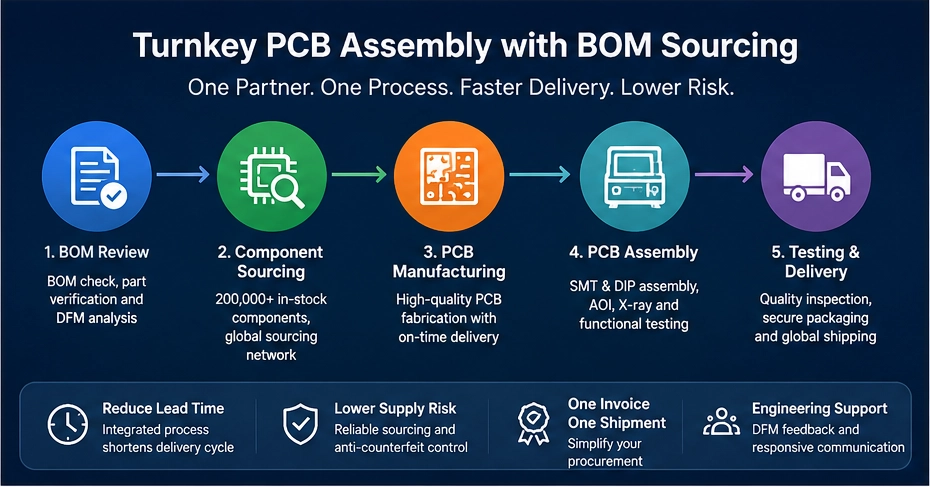
What Is Turnkey PCB Assembly with BOM Sourcing?
Turnkey PCB assembly means a single supplier is responsible for the major production steps, including PCB manufacturing, component procurement, assembly, inspection, testing, and final shipment of the finished PCBs. For many customers, this is a very comfortable way to buy PCBs because the board factory, sourcing department, and assembly department all work from the same production package.
Full turnkey PCB assembly involves the supplier purchasing all of the required components and assembling them into finished PCBs. Partial turnkey PCB assembly is a more flexible option in which the customer supplies selected components, such as pre-programmed ICs, expensive modules, or other parts approved by the customer. The supplier then sources the remaining items in the required BOM.
UMEC supports both models to aid R&D departments, start-ups, industrial OEMs, and purchasing departments alike. A buyer can keep sensitive parts within its own company while having the rest of the production process handled by UMEC for PCB manufacturing, BOM parts purchasing, surface-mount and through-hole assembly, inspection, and final shipping.
Why Is BOM Sourcing the Biggest Bottleneck in PCB Assembly?
Most PCB assembly lead time problems begin before the first component is placed on the PCB. A BOM can contain several types of errors, such as incomplete manufacturer part numbers, obsolete part numbers, incorrect package sizes, unclear substitution parts, obsolete parts, and even long-lead parts at component manufacturers. In addition, parts for low-volume PCBA orders cannot arrive on time because the BOM is not purchased on time due to errors.
Your hardware team is running 100 pilot industrial controllers. All looks good: complete PCB design files, finalized assembly drawing, and what looks to be a straightforward project. However, the sourced power IC has a long lead time, and the approved connector has only one compatible footprint, so that boards can be made quickly, but PCBA delivery is delayed. It could have been prevented by reviewing the BOM earlier in the process.
Conducting a BOM review before bare board production helps identify potential issues early. UMEC’s BOM component sourcing support tool provides the purchasing team with an early assessment of part availability, correct packaging, potential sourcing risks, and possible alternatives while the purchaser is still in the quotation phase. Early visibility into these aspects is far more valuable to the purchasing team than a last-minute rush.
How Does Turnkey PCB Assembly Reduce Lead Time?
PCB assembly lead time is not only the number of days on the production line. It includes file review, quotation clarification, component sourcing, stencil preparation, PCB fabrication, material kitting, SMT scheduling, soldering, AOI and X-ray inspection as needed, electrical testing, packing, and international shipping.
Coordinating step by step with different suppliers at every stage of the process leaves buyers around the globe waiting for answers, sending and forwarding files, and confirming responsibilities, only to solve a small problem. When a single supplier handles PCB assembly, the engineering and procurement teams can address any BOM issues before they hit the production floor. They can plan out the PCB sourcing and production together and handle everything under one roof.
With a manufacturing base in Shenzhen, an English-speaking project support team, and worldwide service experience, UMEC’s manufacturing structure is well-suited to overseas buyers. UMEC supports prototype work with quick turnaround, low-volume / small-batch PCBA production, repeat production, and more. This can enable buyers to move from engineering samples to controlled delivery without restarting the supplier qualification process.
How Does BOM Sourcing Reduce Counterfeit Component Risk?
Counterfeit or untraceable parts can cause hidden failures. A board may test “OK” in initial power-on testing but fail later due to heat, vibration, current load, etc., and eventually fail after long hours of operation. This risk is very high for industrial control, automotive electronics, medical devices, robotics, telecom equipment, AI hardware, etc., and other B2B parts for which field failures are very expensive.
Responsible PCB assembly companies don’t view purchasing components for assembly as “shopping.” Component purchasing for assembly includes BOM cross-checking, component sourcing, inspection of received material, anti-counterfeit verification, and additional buyer-specified verification for allowed component substitutions. UMEC follows quality procedures for incoming component quality control, BOM cross-checks, and assembly inspection methods.
Before purchasing components, the buyer needs to verify the component’s source, traceability, substitution rules, and test requirements to avoid purchasing a lower-cost component that provides no benefit, as it may be subject to rework, warranty claims, or failed certification samples.
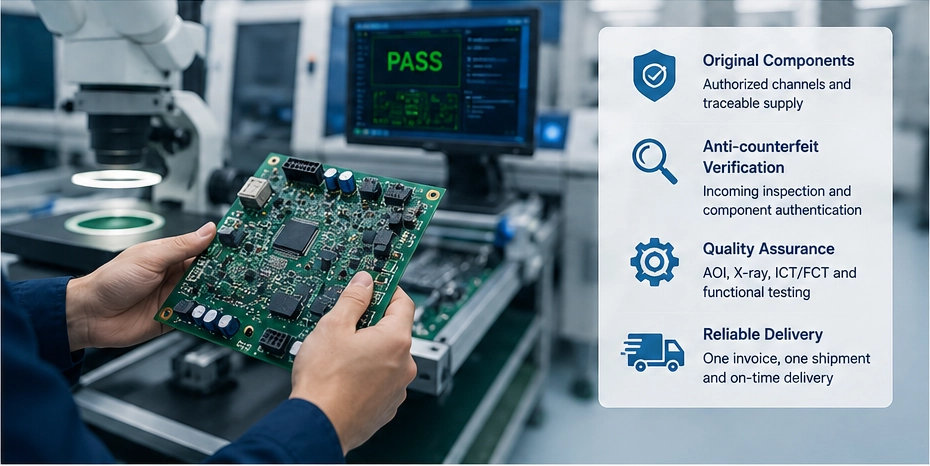
What Should Buyers Check Before Choosing a Turnkey PCB Assembly Supplier?
Evaluating a turnkey PCB assembly supplier is more than just comparing prices. When selecting a supplier, purchasing teams should first determine whether a supplier for PCB fabrication and assembly exists. Next, they should check whether the supplier offers full- and partial-turnkey PCBA services. In addition, BOMs should be reviewed by the supplier before production. Lastly, engineering feedback should be given when files are incomplete.
Process control and inspection capabilities are also key to controlling defects for UMEC’s services in SMT assembly, DIP assembly, AOI, 3D SPI, 3D X-ray, first-article inspection, electrical testing, and ICT/FCT, as required. All work is performed to comply with the appropriate fabrication standards of IPC-A-610, and RoHS-compliant PCBA’s are provided as standard where required. On PCBs with BGAs, fine-pitch components, very dense SMT designs, and designs that require high reliability, all of the above process controls are implemented to minimize the possibility of defective parts being released.
UMEC offers PCB fabrication and PCB assembly services that allow UMEC to serve a wide variety of product types. These include double-sided PCB, multilayer PCB, HDI PCB, rigid-flex PCB, flexible PCB, RF PCB, heavy copper PCB, metal substrate PCB, and ceramic PCB. This allows UMEC’s customers to have one supplier for all of their needs, whether it is a simple through-hole board or a high-density, high-current board for high-frequency applications.
When Should Buyers Choose Full-Turnkey or Partial-Turnkey PCB Assembly?
Full turnkey PCB assembly is generally preferred when a buyer wishes a single supplier to manage components, PCB production, assembly, testing, and delivery. This solution is suitable for small teams, start-up companies, repeat orders, and buyers without a dedicated sourcing department.
Partial turnkey assembly is usually preferred when the buyer already has some of the key components or has pre-approved suppliers for other parts. Also, for projects with programmed ICs, customer-specific parts and modules, high-value chips, or restricted parts, the buyer wants to control these directly. Therefore, the BOM should clearly indicate which parts are customer-supplied and which are supplied by the respective supplier before the quote is finalized.
UMEC’s partial turnkey PCBA support aligns with the typical buyer’s purchasing model. Buyers can maintain control of the critical parts, while UMEC can source the rest of the BOM, fabricate and assemble the PCB, inspect it, and arrange shipment.
Conclusion
By sourcing the BOM for Turnkey PCB assembly, buyers can reduce supplier handoffs, shorten communication lines, lower the risk of using counterfeit components, and make production schedules easier to manage. This is most effective when reviewing all Gerber files, BOM, pick-and-place files, assembly drawings, test procedures, and shipping details as one production package. UMEC’s More Than PCB model connects PCB fabrication with BOM component sourcing, PCBA assembly, quality control, and global shipping. For Purchasing Managers and Hardware Engineers dealing with BOM delays and supplier coordination problems, reviewing with UMEC once can turn all their scattered production tasks into a predictable build. Request a Turnkey PCB assembly quote from UMEC, and UMEC will review the buyer’s files and provide details on component availability, lead time, test procedures, and delivery.
FAQs
Q1: Why is a PCB assembly delayed after the BOM is submitted?
A: PCB assembly is often delayed because the BOM contains missing manufacturer part numbers, wrong package sizes, obsolete parts, long lead-time components, unclear substitutions, or items that do not match the PCB footprint. Early BOM review before PCB fabrication helps reduce these delays.
Q2: How do buyers avoid counterfeit components in turnkey PCB assembly?
A: Working with a supplier who conducts source review, BOM cross-checking, incoming material inspection, anti-counterfeit verification, and also receives approval to substitute parts before assembly can help mitigate counterfeit risk. This is particularly important for industrial, medical, automotive, telecom, and power-electronics-type projects where the use of traceable components is crucial.
Q3: Is full turnkey PCB assembly better than partial turnkey assembly?
A: Full turnkey PCB assembly is better when the buyer wants the supplier to source all components and manage the complete PCBA process. Partial turnkey assembly is better when the buyer supplies key parts and asks the supplier to source the remaining BOM items.
Q4: What files are needed for a turnkey PCB assembly quote with BOM sourcing?
A: A turnkey PCB assembly quote typically requires the following to be provided as clear files to allow UMEC to check both manufacturing and sourcing risk: Gerber files, BOM, pick-and-place files, assembly drawings, quantity, PCB specifications, testing requirements, approved alternates, and shipping destination.
Q5: Can UMEC handle PCB fabrication, BOM sourcing, and PCB assembly in one order?
A: Yes. UMEC supports PCB fabrication, BOM component procurement, SMT assembly, DIP manual assembly, PCBA inspection and testing, and finished PCBA delivery. It is a one-stop shop that reduces the number of middlemen for buyers who require such a service delivery model.
Q6: Can UMEC source components from authorized distributors only?
A: Yes, ensuring traceability, it supports customer-designated channels.
Q7: What is the typical lead time for turnkey PCB assembly with BOM sourcing?
A: The standard delivery time is 7-15 working days, depending on the complexity of the BOM and the availability of components.