
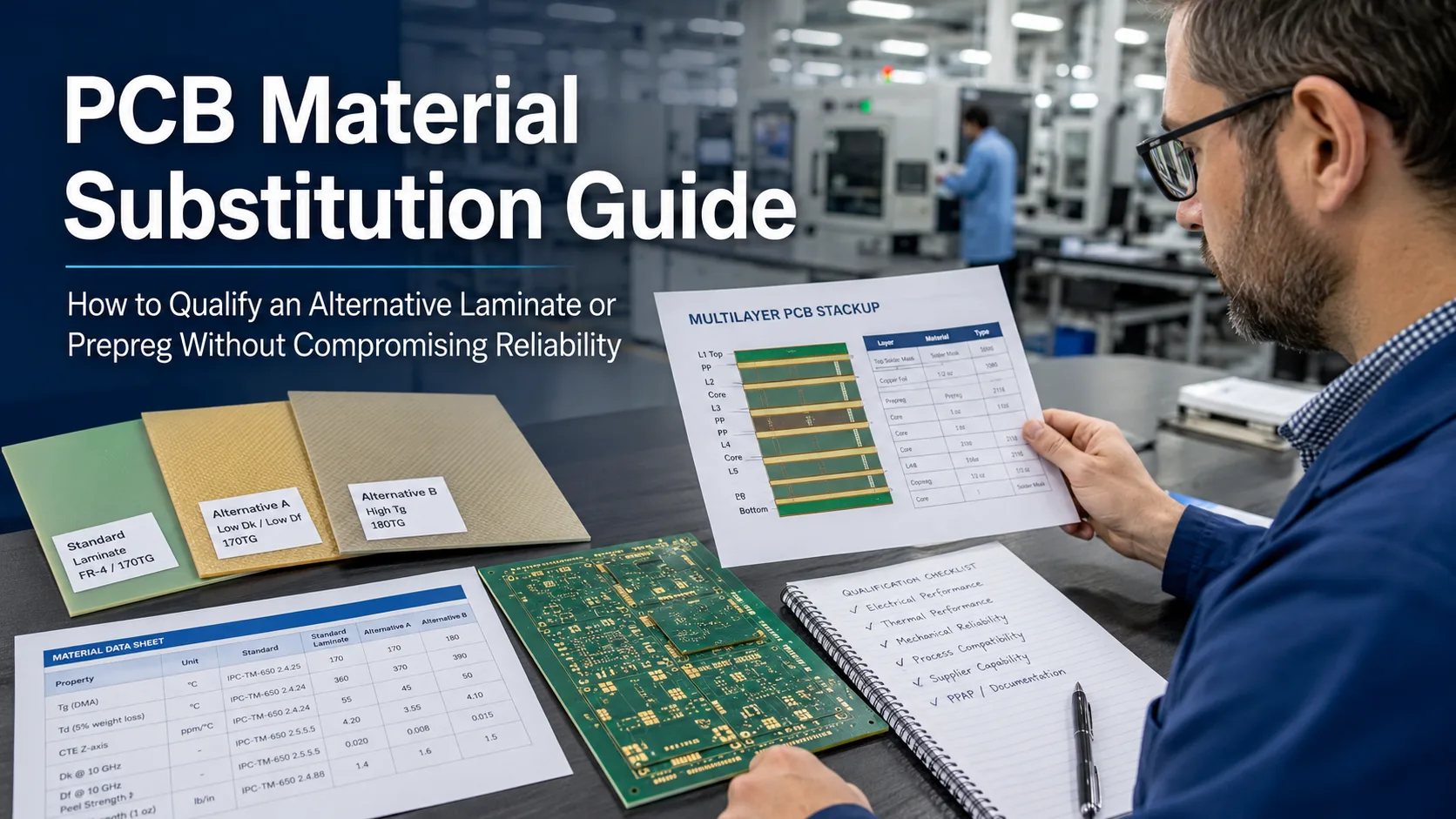
PCB material substitution becomes necessary when an approved laminate or prepreg is unavailable, discontinued, or unable to support a production schedule. The challenge is not finding a datasheet with similar numbers. It is proving that the replacement will preserve the electrical behavior, processing window, compliance status, and reliability of the finished board. For OEM buyers, engineers, and quality teams, a sound decision requires a documented comparison of the original material, the proposed alternative, the complete stackup, and the application.
When Should a PCB Material Substitution Be Considered?
Supply Shortages, Discontinuation, and Second Sources
A substitution review is appropriate when the original grade has been discontinued, is based on a single source, or cannot meet the required delivery window. It may also be needed when an OEM requires a qualified second source before volume production. UMEC’s CCL and prepreg supply update provides market context, but each decision must be based on the project’s material grade, construction, quantity, and approval rules.
First, determine whether the constraint is temporary or structural. A temporary allocation may be handled through material reservation, split deliveries, or a revised schedule. A discontinued or single-source construction usually requires formal qualification. Prototype teams also need to confirm that the replacement can support later production; otherwise, validation may need to be repeated.
When Substitution Is the Wrong Response
Replacement should be paused when the drawing prohibits changes, the material is part of a regulatory or customer qualification, the design is not frozen, or there is no time for the required review. A statement such as “same Tg” or “equivalent FR-4” is not sufficient. If comparable data, stackup analysis, or customer approval cannot be obtained, waiting for the original material may carry less risk than introducing an undocumented change.
Why Similar Laminates or Prepregs Are Not Automatically Equivalent
CCL Core and Prepreg Create Different Risks
Copper-clad laminate cores provide defined dielectric and copper layers. Prepreg bonds the layers during lamination and forms the dielectric after resin flow and curing. They therefore require different substitution checks.
Two prepregs with a similar glass style may produce different pressed thicknesses because resin content, flow, copper distribution, and lamination conditions vary. The change can affect finished thickness, resin fill, voiding, and controlled impedance. Procurement needs to confirm the full core-and-prepreg construction rather than approve a replacement from a product name alone.
IPC-4101 covers laminate and prepreg base materials used primarily for rigid and multilayer printed boards. A matching specification sheet can support screening, but it does not prove approval for a specific stackup or application.
Why Tg or a Material Category Is Not Enough
Tg describes a single thermal transition; it does not indicate decomposition resistance, Z-axis expansion, dielectric behavior, CAF resistance, or processing compatibility. A higher-Tg material usually still requires different fabrication conditions.
The same caution applies to “low loss,” “high speed,” and similar categories. Datasheets may use different test methods or frequencies, so Dk and Df values may not be directly comparable. Buyers should request current datasheets and test conditions before treating two materials as alternatives.
What Specifications Must Be Compared Before Approval?
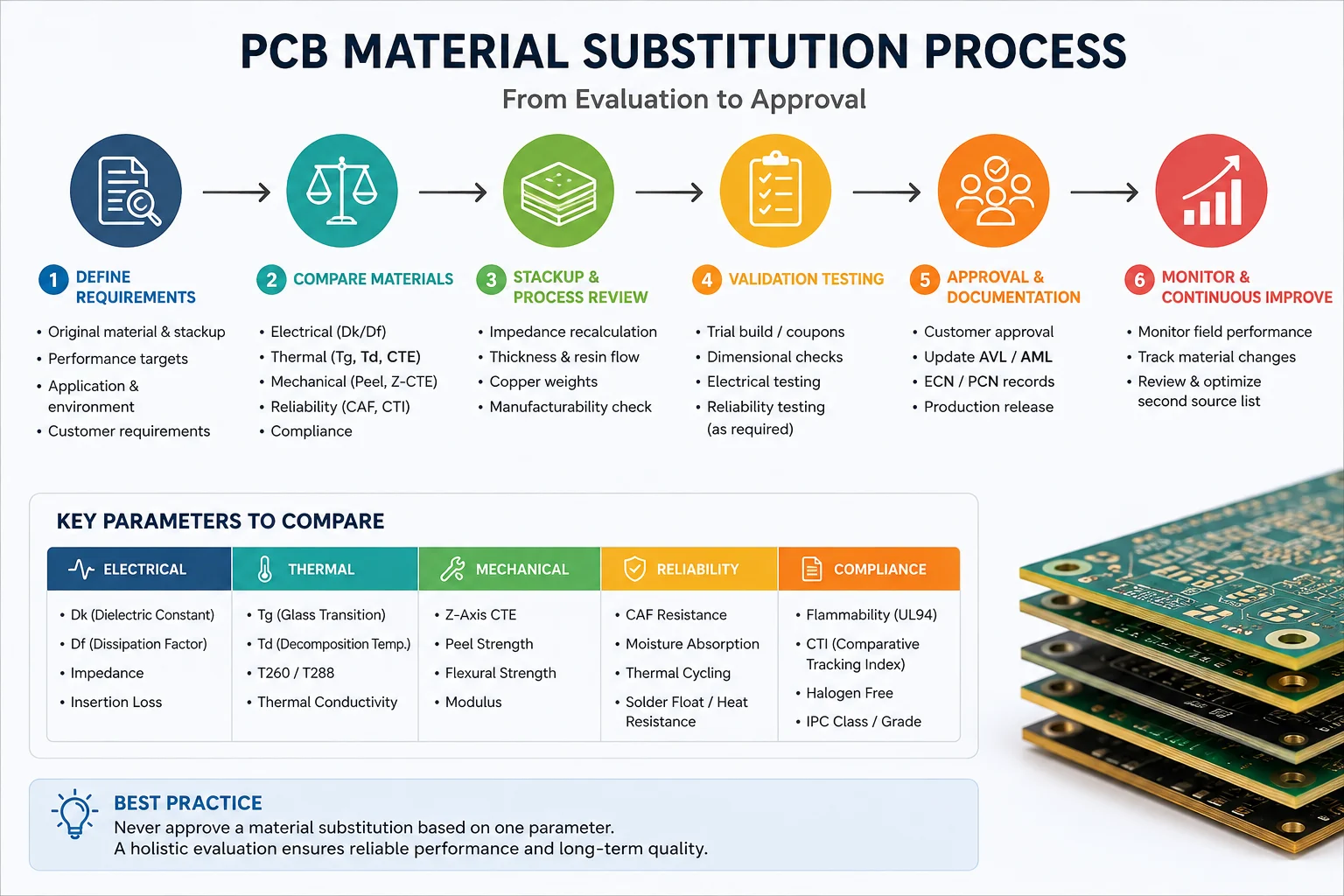
| Evaluation area | Parameters to review | Main risk | Evidence to request |
|---|---|---|---|
| Electrical | Dk, Df, impedance, loss | Impedance shift or excess loss | Datasheet and stackup analysis |
| Thermal | Tg, Td, T260/T288 where relevant | Delamination or thermal damage | Test method and limits |
| Mechanical | Z-axis CTE, peel strength | PTH, microvia, or adhesion failure | Reliability and process data |
| Lamination | Thickness, prepreg style, resin content and flow | Voids, poor fill, thickness variation | Construction data |
| Reliability | Moisture, CAF, CTI | Leakage or insulation failure | Qualification evidence |
| Compliance | IPC sheet, flammability, customer rules | Approval conflict | Current documents and sign-off |
Electrical Performance and Stackup Impact
Changing the laminate or prepreg may require revisions to dielectric thickness, trace width, or spacing. This is especially important for controlled-impedance, high-speed digital, long-channel, and RF designs. A lower published Dk does not automatically improve performance because the result also depends on copper geometry, surface profile, fabrication tolerances, and the complete stackup.
For ordinary boards without tight electrical requirements, a documented review of materials and processes may be adequate. Higher-risk designs require impedance recalculation, loss modeling, and test coupons based on the application’s data rate, frequency, channel length, and loss budget.
Thermal, Mechanical, and Long-Term Reliability
Td and time-to-delamination data may be more relevant than Tg during repeated thermal exposure. Z-axis CTE is important for plated holes and microvias, while moisture and CAF performance are more important in dense, high-voltage, or humid applications.
IPC-TM-650 includes methods for microsectioning, peel strength, thermal stress, Tg and Z-axis expansion, Td, impedance, signal loss, thermal cycling, moisture, and insulation resistance. The required tests should be selected based on product risk, customer specifications, and operating conditions rather than on a universal checklist.
How Should an Alternative Material Be Qualified?
Use a Risk-Based Validation Plan
A standard FR-4 board with unchanged construction usually requires a datasheet comparison, process review, and confirmation of thickness and electrical requirements. A new prepreg construction, high-layer-count board, HDI build, high-speed channel, or RF hybrid normally needs deeper analysis because the material affects both fabrication and performance.
A practical qualification path includes document review, revised stackup and impedance calculations, process assessment, a trial build or coupon where justified, relevant inspections or tests, and controlled release with written approval.
A trial build should be considered when the change affects pressed thickness, resin behavior, drilling response, microvias, impedance, or reliability assumptions. It may be unnecessary for a lower-risk change when objective evidence and prior process history support compatibility.
Know When to Reject the Candidate
Reject the alternative when the drawing forbids substitution, the revised stackup cannot meet thickness or impedance requirements, test methods are not comparable, required compliance coverage is missing, or the source and lot cannot be traced. If evidence is incomplete, the practical choices are to wait for the original material, assess another candidate, revise the design, or adjust the schedule.
Who Should Approve the Material Change?
Procurement can identify the supply or cost problem, but it should not approve the technical substitution alone. The fabricator should propose a manufacturable candidate and explain process effects. Design engineering should review electrical and stackup implications. Quality or reliability personnel should define the evidence, while the customer or designated design authority provides final approval when the material is controlled.
The record should include both materials, datasheet revisions, the revised stackup, evidence, source and lot information, approval status, and updates to the approved material list.
How to Choose a PCB Supplier for Material Substitution
A capable supplier should offer more than access to a replacement sheet. Buyers need to ask whether the material has been processed in a comparable construction, how incoming lots are traced, who recalculates the stackup, what evidence is available, and how customer approval is recorded.
UMEC publishes a documented qualification approach and a range of qualified PCB base materials, including standard FR-4, high-Tg, lower-loss, and advanced families. The page also notes that some advanced materials or builds may be sourced from a single supplier.
Board type matters. In multilayer PCB manufacturing, resin flow, dielectric construction, copper distribution, and pressing behavior must be assessed together. For HDI PCB material requirements, thin dielectrics, sequential lamination, microvias, and controlled impedance narrow the substitution window. UMEC’s HDI page lists mid- and high-Tg, halogen-free, high-CTI, high-speed, and high-frequency material categories.
A complete RFQ usually includes the original material, proposed candidate if known, Gerber and drill files, stackup, core and prepreg construction, copper weights, finished thickness, impedance, application, operating environment, quantities, required delivery date, and customer approval conditions.
How to Prevent Future Material Shortages
Second-source planning is most effective before volume release. Single-source laminates, uncommon prepregs, exact copper profiles, and narrow thicknesses should be identified during stackup development.
Specifications should separate critical performance requirements from brand preferences. An approved material list may provide flexibility for standard applications, while brand-specific control may remain necessary for high-speed, RF, regulated, or customer-qualified products. Every alternative should remain linked to its application, construction, and supporting evidence rather than being treated as universally interchangeable.
Through long-term customer service, UMEC has developed a proactive strategy for addressing sheet metal shortages:
Establishing Safety Stock: Maintaining 1-2 months’ worth of safety stock for commonly used sheet metals (such as S1000H and standard FR-4) to buffer against short-term delivery fluctuations.
Multiple Supplier Alternatives: Securing 2-3 qualified suppliers for each core sheet metal category to avoid the risk of supply disruption from a single supplier.
Advancing Demand Forecasting: Based on customer order forecasts, locking in material delivery dates in advance and initiating alternative plans for materials with long lead times.
Technology Research and Development: Regularly conducting process verification for new sheet metals and establishing a reserve of alternative materials to provide a rapid response capability for unexpected material shortages.
Conclusion
Reliable PCB material substitution requires more than matching Tg or selecting an available laminate. The candidate must be reviewed against the application, complete stackup, fabrication process, reliability risks, and change-control requirements.
For a project-specific assessment, submit the original specification, proposed alternative, Gerber files, stackup, impedance targets, application, quantities, and required delivery date through a request for a PCB material compatibility review. UMEC can use the RFQ information to identify issues that must be resolved before quotation, trial production, or customer approval.
Frequently Asked Questions
Can one PCB laminate replace another?
Possibly, but similar categories do not prove equivalence. Compare key requirements, review the production stackup, and obtain the required approval.
Can high-Tg FR-4 replace standard FR-4?
It depends on the application. Higher Tg does not confirm that Td, CTE, Dk/Df, thickness, CAF, CTI, processing behavior, and compliance requirements are suitable.
Does changing prepreg affect controlled impedance?
It can. Resin content, glass style, flow, and pressed thickness affect dielectric construction. Controlled-impedance designs should be recalculated using the proposed production stackup.
Does every PCB material substitution require a trial build?
No. Low-risk changes may rely on documents and process history, while HDI, high-speed, RF, or qualified products may require testing.
Can a PCB manufacturer change materials without customer approval?
Only when the drawing, purchase specification, and change-control agreement permit it. A material affecting performance, compliance, or qualification should not be changed without documented authorization.
How can procurement plan order scheduling to avoid project delays?
Establish a three-tiered scheduling mechanism:
1. For mature mass-production projects, place PCB orders 4 weeks in advance to allow for substrate procurement time;
2. Finalize the Gerber design for R&D prototypes on the first attempt to prevent mid-process revisions and material re-preparation;
3. For new projects, deliver in batches, prioritizing small-batch prototype deliveries and delaying large-batch deliveries until material lock-in. A 1-week expedited buffer is also reserved to address material delivery delays. UMEC can simultaneously provide customers with feedback on current lead times for each substrate series, helping procurement develop a reasonable order-scheduling table.