
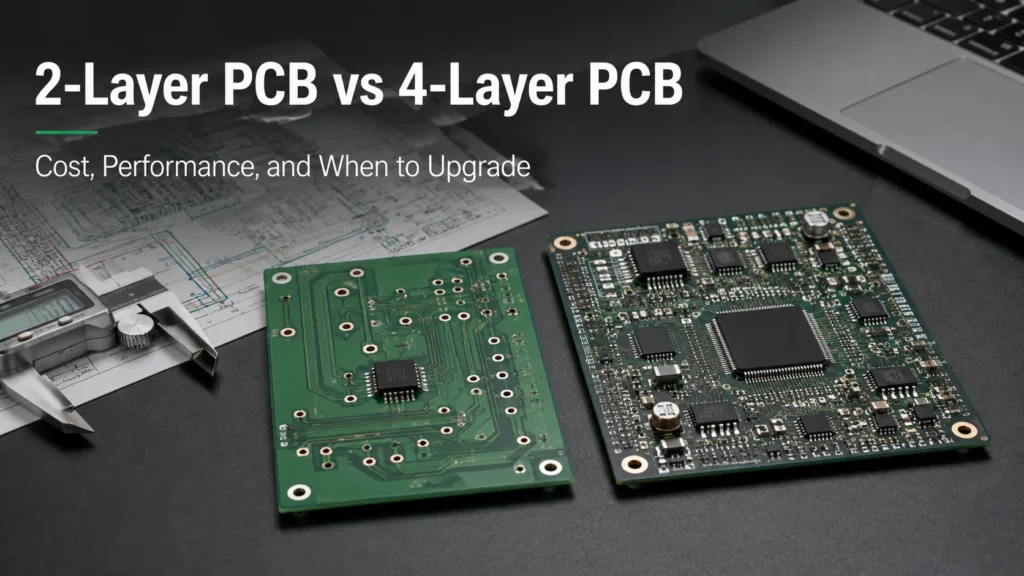
Choosing between a 2-layer PCB and a 4-layer PCB is not just a bare-board price decision. A 2-layer board is usually simpler to fabricate, but routing congestion, board size, return-path quality, EMI risk, controlled impedance, and redesign work can change the total project cost. The real question is whether a 2-layer layout still meets the product’s electrical and mechanical requirements without creating avoidable risk later.
2-Layer or 4-Layer PCB? A Quick Decision Guide
A 2-layer PCB is practical when routing fits comfortably, board size is not tightly constrained, and you can maintain useful ground copper. A 4-layer PCB becomes more attractive when density rises, critical signals need a cleaner reference structure, or routing is difficult without compromising ground and power distribution.
| Design condition | 2-layer PCB | 4-layer PCB | Main decision factor |
| Simple, low-density routing | Often suitable | Usually unnecessary | Manufacturing simplicity |
| Tight board space | More restrictive | Often preferred | Routing freedom |
| Clean reference structure | Possible with care | Easier | Return-path control |
| EMI-sensitive design | More layout discipline | Often easier | Plane structure |
| Controlled impedance | Application-dependent | Usually easier | Stackup control |
| Lowest bare-board cost | Usually favored | Higher complexity | Unit PCB price |
Choose the lowest-risk layer count that still meets electrical, mechanical, and cost requirements.
Why Does a 4-Layer PCB Cost More Than a 2-Layer PCB?
Bare-Board Cost: What Actually Changes When You Add Two Layers?
A 4-layer PCB requires additional copper and dielectric layers, inner-layer processing, lamination, and registration. If controlled impedance or a specific stackup is required, further manufacturing controls may apply. The exact 2-layer vs. 4-layer PCB cost difference therefore depends on the design, not a universal percentage.
Compare quotes using the same board dimensions, base material, finished thickness, copper weight, surface finish, hole requirements, quantity, and testing expectations. Otherwise, a lower quote may represent a different specification.
For designs that remain technically comfortable on two layers, double-sided PCB manufacturing can keep construction simple. UMEC’s published 2-layer examples use FR-4 and include HASL and ENIG surface-finish options.
When Can a Cheaper 2-Layer PCB Cost More Overall?
A 2-layer PCB can become more expensive at the project level if engineers must enlarge the board, force difficult routing, accept weaker return paths, or build another prototype after EMI or signal-integrity problems appear.
When Routing Congestion and Board Size Erase the 2-Layer Cost Advantage
Two layers can work well when critical nets stay direct, and enough copper remains available for ground. Warning signs include long routing detours, excessive vias, narrow channels, fragmented ground copper, or a board outline growing mainly to create routing room.
A larger 2-layer board can reduce the expected unit-cost advantage, especially if board dimensions affect panel use or enclosure size. The better comparison is between two manufacturable designs that provide the same function and fit the same product constraints.
Before adding layers, review placement, connector positions, critical-net routing, and ground area. If those changes still leave the layout crowded, a 4-layer PCB may be the more rational option.
When EMI, Signal Integrity, or a PCB Re-Spin Costs More Than Two Extra Layers
Dense 2-layer layouts can make it difficult to maintain useful ground near important signals. Poor return paths can contribute to emissions, susceptibility, crosstalk, or difficult debugging. Signal edge rate, trace geometry, nearby reference copper, interface requirements, and the total return-current path matter; clock frequency alone is not a reliable layer-count rule.
A 4-layer structure provides more practical options for continuous reference planes and controlled routing, but extra layers do not automatically solve EMI. Stackup, placement, routing, transitions, and grounding still matter.
The purchasing question is whether the added fabrication cost is smaller than another layout revision, prototype build, engineering cycle, or EMC retest.
How to Know When Your Design Should Move From 2 Layers to 4 Layers
Use These Design Triggers Before Locking the Layer Count
No single trace count, data rate, or component count determines when to use a 4-layer PCB. Look for several triggers together: routing repeatedly breaks up ground copper; dense packages force long detours or many vias; the board outline is growing mainly for routing; high-speed interfaces need more predictable reference paths; controlled impedance is required; or EMI/EMC margin is becoming important.
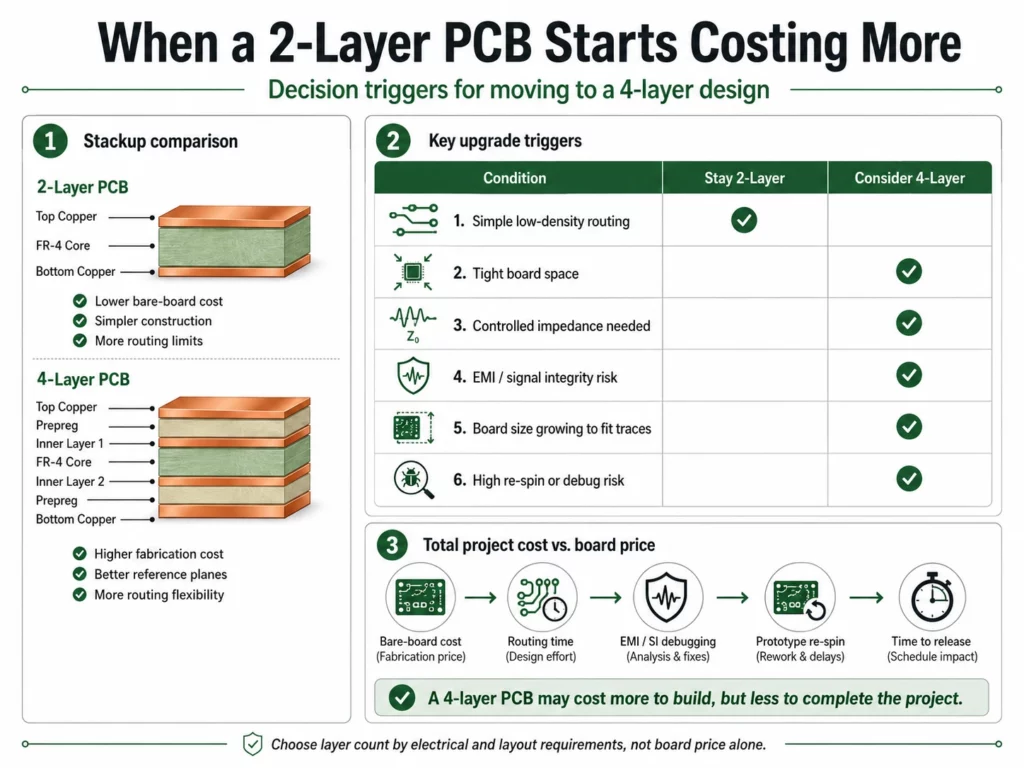
Staying with two layers still makes sense when routing is straightforward, space is available, the ground strategy remains clean, and the electrical requirements do not justify extra-layer complexity.
If the design falls between those cases, an early PCB design and layout support review can be more useful than choosing four layers simply as a safety margin. UMEC publishes PCB design and layout capabilities alongside fabrication services.
How to Prevent Paying for More PCB Layers Than You Actually Need
Improve the Layout Before Adding Layers—but Do Not Force a Marginal 2-Layer Design.
Cost control should start with layout choices. Better component placement can shorten critical nets, preserve ground copper, and reduce routing bottlenecks without changing layer count.
Forcing a 2-layer design can still be a false economy if it requires aggressive spacing, fragmented ground, excessive vias, or an unnecessarily large PCB. The goal is to avoid unnecessary layers without creating a board that is cheap to fabricate but costly to debug or revise.
What Do You Need To Confirm Before Requesting 2-Layer and 4-Layer PCB Quotes?
Send the Same Manufacturing Requirements for an Apples-to-Apples Cost Comparison
A useful RFQ should let the supplier compare both constructions on equal terms. Provide production files, board dimensions, quantity, material, finished thickness, copper weight, surface finish, hole requirements, testing needs, and any controlled-impedance requirement. State whether the build is a prototype or intended for production.
“4-layer PCB cost” is not a complete manufacturing specification; two quotes can differ for reasons unrelated to layer count.
If four layers are selected, the stackup should fit the electrical and manufacturing requirements rather than simply adding two internal copper layers. A supplier with multilayer PCB manufacturing capability should be able to identify specifications that materially affect manufacturability or quotation. UMEC’s multilayer page covers 4-layer and higher PCB structures and notes the importance of dielectric construction to impedance and signal integrity.
How to Choose a PCB Manufacturer for a 2-Layer-to-4-Layer Design Decision
Compare Engineering Support, Manufacturing Capability, and Quote Transparency
When layer count is still open, supplier selection should include more than unit price. A useful manufacturing partner must support both 2-layer and multilayer builds, review production files, and explain which specifications drive cost.
Procurement teams should be able to see whether a price change comes from layer count, material, board size, copper weight, finish, design rules, or impedance control.
SZ UMEC CO., LTD provides double-sided and multilayer PCB manufacturing pages, along with PCB design and layout services. Its website also describes a process in which customers upload Gerber files, configure manufacturing requirements, and receive a quotation and DFM feedback. This supports a layer-count decision based on actual build requirements rather than a generic cost assumption.
Conclusion
A 2-layer PCB is often economical for simple, electrically manageable designs. A 4-layer PCB becomes more compelling when routing density, return paths, controlled impedance, EMI risk, or redesign cost outweigh the savings of a simpler board.
Before requesting pricing, prepare the Gerber files, board dimensions, material, thickness, copper weight, surface finish, quantity, impedance needs, and production stage. For a project ready for supplier review, contact UMEC with the relevant files and manufacturing details. The company’s contact page accepts PCB files and quotation requests.
FAQs
Is a 4-layer PCB always better than a 2-layer PCB?
No. Four layers add routing and reference-plane options, but a well-designed 2-layer PCB may be more economical for simpler circuits. Layer count needs to follow actual design requirements.
How much more does a 4-layer PCB cost than a 2-layer PCB?
There is no reliable fixed percentage. Cost depends on size, material, copper weight, finish, quantity, stackup, testing, and impedance requirements. Compare both options using identical specifications.
Can a 2-layer PCB handle high-speed signals?
It can, depending on signal edge rate, routing geometry, reference paths, interface requirements, and EMI constraints. Dense routing can make those conditions harder to maintain.
Does a 4-layer PCB automatically solve EMI problems?
No. Additional layers can make reference planes and return paths easier to implement, but EMI performance still depends on stackup, placement, routing, grounding, and transitions.
When should I switch from a 2-layer PCB to a 4-layer PCB?
Consider switching when routing congestion, fragmented ground, board-size growth, controlled impedance, EMI risk, or redesign cost becomes significant. Judge the total project, not layer count alone.