
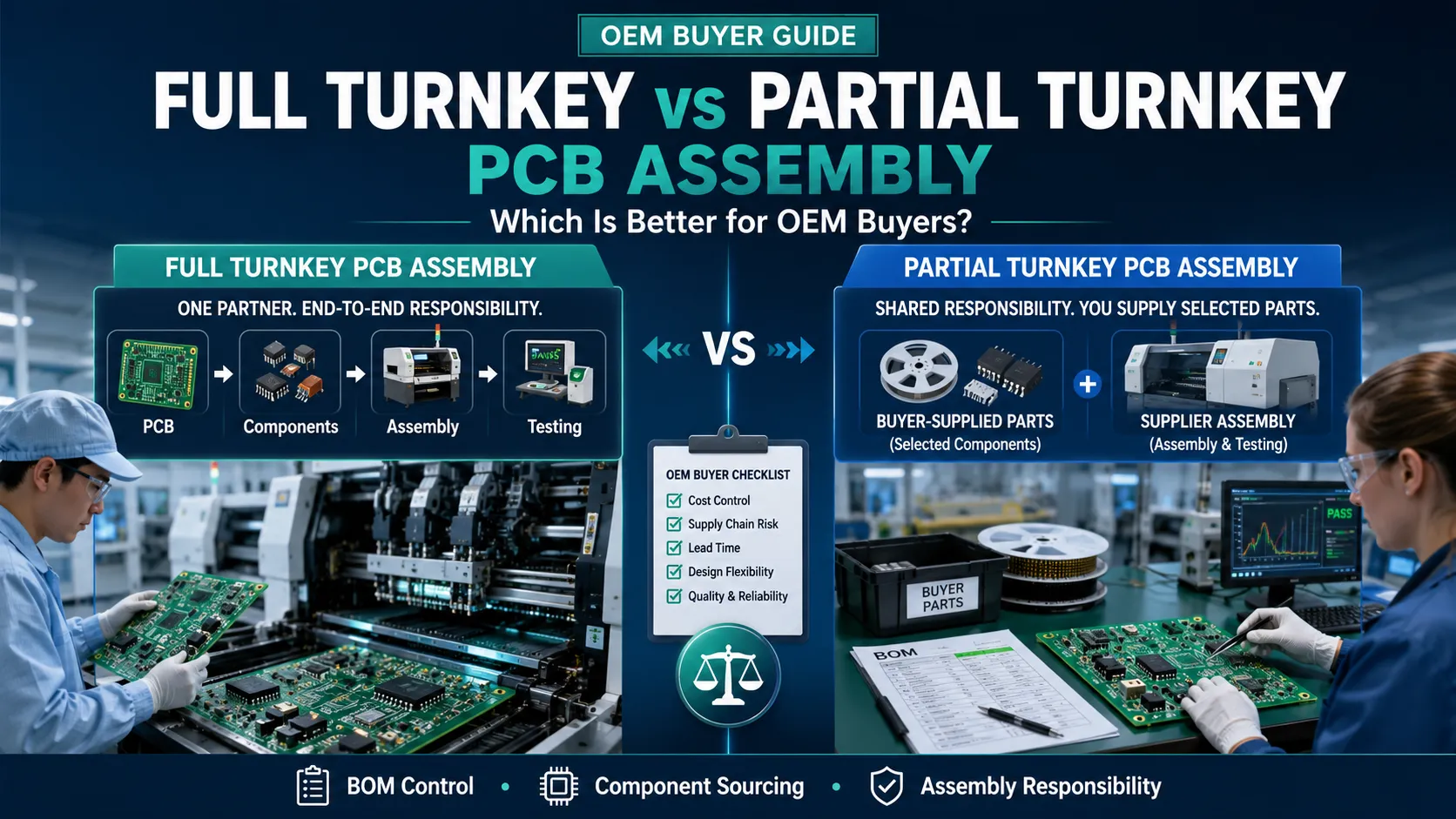
OEM buyers often compare full turnkey vs. partial turnkey PCB assembly when deciding who should manage PCB fabrication, component sourcing, assembly, testing, and delivery. The choice affects BOM control, lead time, cost, supplier responsibility, and the risk of repeat production. A full turnkey model may reduce supplier handoffs, while a partial turnkey model may give the buyer more control over approved or sensitive components. The right choice depends on the project stage, component availability, testing requirements, and the level of sourcing responsibility the buyer wants to retain.
Full Turnkey vs Partial Turnkey PCB Assembly: The Core Difference
What does a full turnkey PCB assembly mean?
Full turnkey PCB assembly means the supplier manages most of the PCBA workflow, including PCB fabrication, BOM sourcing, component procurement, SMT assembly, through-hole assembly, inspection, testing, and shipment when required. This model is useful when an OEM buyer wants a single supplier to coordinate the entire production process rather than managing a PCB supplier, a component supplier, and an assembly partner separately.
What does a partial turnkey PCB assembly mean?
Partial turnkey PCB assembly means the buyer supplies selected components, while the supplier handles the sourcing of the remaining BOM components, PCB fabrication, assembly, and testing. This is common when the buyer already controls key ICs, programmed parts, certified modules, expensive components, or approved supply channels.
Where does a consigned or kitted PCB assembly fit?
For consignment PCB assemblies or kit-type PCB assemblies in certain procurement contexts, the buyer will supply either all or most of the parts. The assembler carries out the placement, soldering, testing, and inspection. This technique is good for an established project but requires accurate labeling, a correct number of parts, correct SMT packaging, and a BOM match.
Responsibility table: buyer vs supplier
| Responsibility | Full Turnkey | Partial Turnkey | Consigned Assembly |
| تصنيع PCB | Supplier | Supplier | Supplier or buyer |
| Component sourcing | Supplier | Shared | Buyer |
| Critical components | Supplier or buyer-approved | The buyer often supplies | Buyer supplies |
| إدارة BOM | Supplier-led | Shared | Buyer-led |
| Assembly | Supplier | Supplier | Supplier |
| Testing | Supplier, if required | Supplier, if required | Supplier, if required |
When Should OEM Buyers Choose Full Turnkey PCB Assembly?
When the buyer does not have a component sourcing team
Full turnkey PCB assembly is often well-suited for overseas OEM buyers, R&D teams, equipment manufacturers, and hardware companies that lack a local component sourcing team. In this case, the supplier helps reduce the workload of finding components, checking availability, and coordinating delivery before assembly.
When one supplier should manage PCB fabrication, BOM sourcing, and assembly
Full turnkey is useful when the buyer wants PCB fabrication, BOM sourcing, SMT assembly, DIP assembly, and testing managed within a single production workflow. For projects that require both bare board production and PCBA delivery, the supplier’s PCB assembly service should be reviewed before quotation.
When a full turnkey can reduce supplier handoffs
Every handoff creates risk. A PCB file may be revised after components are purchased. A component package may not match the footprint. A substitute part may affect soldering, firmware, or testing. A full turnkey solution can reduce these communication gaps by keeping PCB fabrication, component sourcing, and assembly planning within one coordinated workflow.
Risks to check before choosing a full turnkey
Full turnkey does not mean the buyer should give up technical control. Before choosing this model, buyers should check whether the BOM is complete, whether substitute parts require approval, whether testing requirements are defined, and whether the supplier can support repeat production records for future orders.
When Is Partial Turnkey PCB Assembly the Better Choice?
When the buyer has approved critical components
Partial turnkey PCB assembly is often better when the buyer already has approved MCUs, ICs, wireless modules, sensors, connectors, or programmed components. These parts may affect performance, firmware, certification, or product consistency, so the buyer may prefer to supply them directly.
When customer-supplied parts must stay under buyer control
Some customer-supplied components cannot be freely replaced. This may include locked-source components, certified parts, long-term supply agreements, or high-value ICs. In these cases, partial turnkey allows the buyer to keep control of key components while the supplier handles standard parts and assembly.
When partial turnkey helps balance flexibility and supplier support
Partial turnkey can be a practical middle ground. The buyer controls sensitive components, while the supplier handles common passives, connectors, PCB fabrication, SMT assembly, through-hole assembly, and PCBA testing. This can reduce sourcing workload without losing control over critical BOM items.
Risks of unclear supplied components
Customer-supplied components can delay assembly if the quantity is short, the labels do not match the BOM, the packaging is not suitable for SMT feeders, or the cut tape is too short for production handling. Buyers should provide a list of supplied components, package types, designator mappings, quantities, and overages before production starts.
Full Turnkey vs Partial Turnkey: Cost, Lead Time, and Supply Chain Risk
Unit price vs total project cost
However, a good model is not always the one that has the lowest unit price. Project costs include purchasing parts, freight, supplier communication, design engineer issue resolution, delays due to shortages, rework, testing, and controlling future purchases. A cheap estimate for assembly can prove costly due to an incomplete BOM or late parts delivery.
How does component sourcing affect lead time?
Lead time depends heavily on component availability. Long-lead, obsolete, single-source, or unclear parts can delay full turnkey production. In partial turnkey projects, the supplier also needs to know which parts are supplied by the buyer and which parts should be sourced by the supplier.
How do customer-supplied components delay assembly?
Partial turnkey and consigned assembly depend on customer-supplied parts arriving correctly and on time. Missing reels, mixed labels, moisture-sensitive components without proper packaging, or insufficient overage can stop assembly even when the PCB is ready.
How does BOM management affect repeat production?
For OEM buyers, repeat production is often more important than the first batch. BOM records, substitute approval rules, component lifecycle status, and sourcing history should be managed carefully so future builds can follow the same technical decisions.
What Files and Component Details Are Needed Before Quotation?
Gerber files and PCB specifications
Gerber files should include PCB specifications such as layer count, board thickness, copper thickness, material requirements, surface finish, solder mask, quantity, and any special fabrication notes. Final material and stack-up choices should be verified against the application.
BOM with manufacturer part numbers
A quotation-ready BOM should include manufacturer part numbers, designators, quantity per board, package, approved alternatives, and no-substitute notes. For full turnkey builds, BOM sourcing and component procurement depend on clear part data.
Pick-and-place / CPL file
The pick-and-place file, or CPL file, provides component position, rotation, and board-side information. It is especially important for fine-pitch components, QFN, BGA, polarized parts, and double-sided SMT assembly.
Assembly drawing and polarity notes
Assembly drawings help clarify connector direction, polarity marks, DIP component location, mechanical constraints, and special soldering instructions. These notes help reduce avoidable assembly errors and first-article issues.
Supplied component list, packaging, and overage
For partial turnkey or consigned projects, buyers should list every supplied component, corresponding designators, quantities, package formats, batch information, and any overage. SMT components should be provided in packaging that supports the planned assembly process.
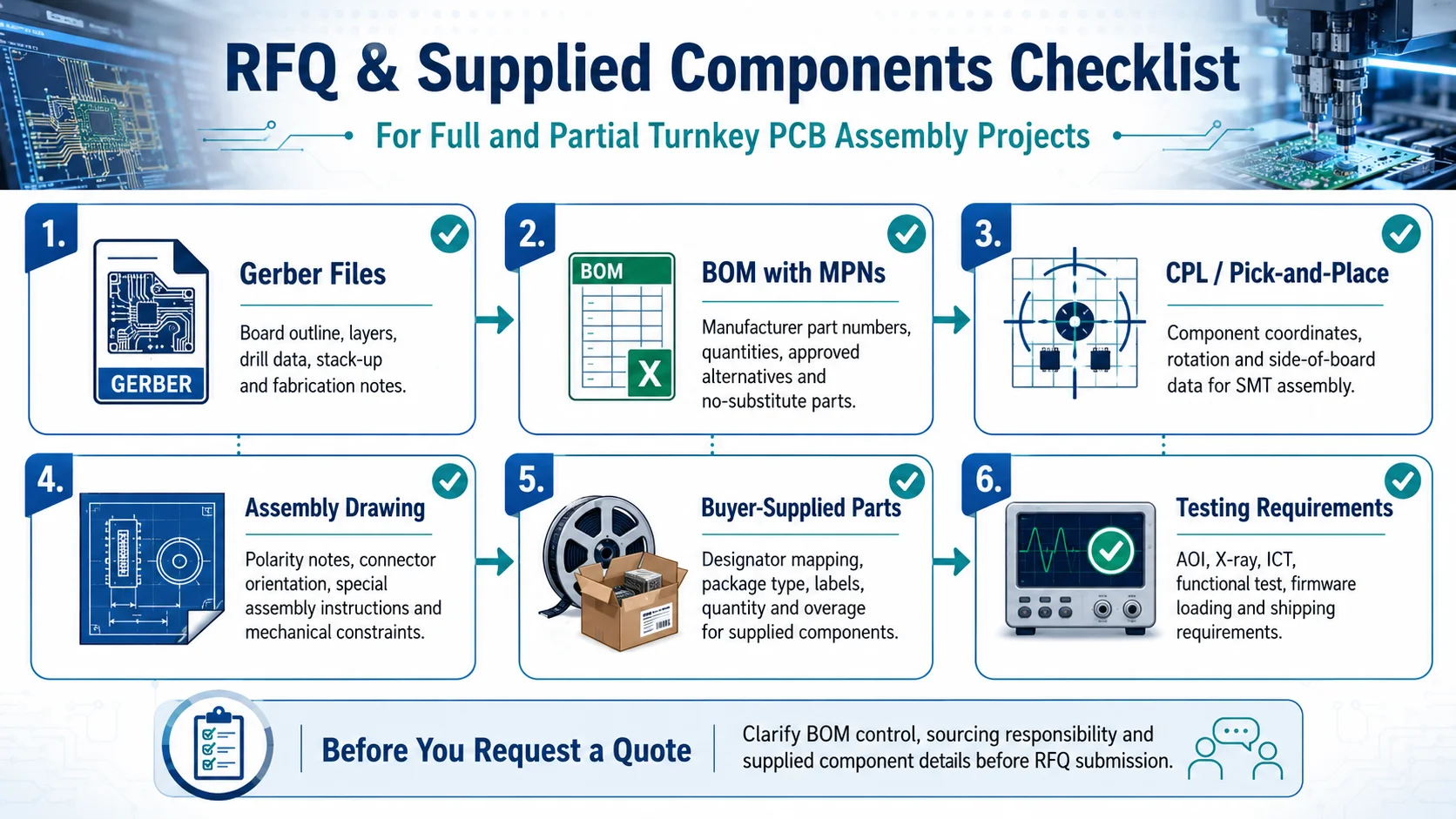
Testing requirements and shipping details
Testing requirements should be defined before quotation. Buyers should specify whether AOI, X-ray, ICT, flying-probe, firmware loading, or functional testing is required. Shipping destination, packing requirements, and target delivery timing should also be included.
Decision Matrix: Which PCB Assembly Model Fits Your Project?
Prototype and R&D projects
For early prototypes, a full turnkey is often practical because the buyer may not yet have a stable component sourcing channel. The supplier can help review the BOM, source components, and build a small batch for engineering validation.
OEM pilot production
Pilot production may use a full or partial turnkey approach. If the BOM is still being tested, a full turnkey may reduce the workload. If key components are already approved, a partial turnkey may give better control.
Repeat production with locked components.
For mature products, partial turnkey or consigned assembly may be a better fit if the buyer already has stable components, approved suppliers, or internal inventory. The decision depends on whether the buyer wants to keep managing the supply chain.
Legacy or replacement PCBA projects
Legacy or replacement PCBA projects may require hard-to-find, customer-approved, or reclaimed components. In these cases, a partial turnkey arrangement may be useful, as the buyer can supply critical parts while the supplier handles PCB fabrication and assembly.
Industrial electronics projects
Industrial electronics projects often require stable BOM control, clear testing requirements, and repeat production consistency. The assembly model should be selected based on component risk, operating environment, and long-term supply needs.
How to Choose a Supplier for Full or Partial Turnkey PCB Assembly in China
Check PCB fabrication, component sourcing, and PCB assembly capability
A qualified supplier should connect PCB fabrication, component sourcing, assembly, inspection, and testing. For projects that require fewer supplier handoffs, working with UMEC, a one-stop PCB manufacturing partner in China, can help coordinate PCB fabrication, component sourcing, and PCBA assembly within a single workflow.
Check the BOM review and substitute approval process.
Buyers should ask how the supplier reviews missing MPNs, package mismatches, obsolete parts, approved alternatives, and no-substitute components. The supplier should not replace critical parts without the buyer’s approval.
Check SMT/DIP assembly and PCBA testing support.
The supplier should support the assembly process required by the design, including SMT, through-hole, mixed-assembly, inspection, and PCBA testing as needed. Testing scope depends on board complexity, application risk, and buyer-provided procedures.
Check communication, RFQ feedback, and repeat order control
Clear engineering communication is important for overseas OEM buyers. The supplier should identify missing files, unclear BOM items, risks associated with customer-supplied parts, and testing requirements before the project moves into production.
Why UMEC fits full and partial turnkey PCBA projects
UMEC’s confirmed service chain covers PCB fabrication, component sourcing, PCB assembly, and PCBA testing for custom electronics projects. For buyers comparing full-turnkey and partial-turnkey models, UMEC can support projects in which the supplier sources the BOM, as well as those in which the buyer supplies selected key components. When a project involves multiple board technologies before assembly, buyers can also review the PCB product matrix by category, including HDI, multilayer, rigid-flex, flexible, RF, heavy copper, and ceramic PCBs.
Conclusion
Full turnkey PCB assembly is often suitable for OEM buyers who want a single supplier to manage PCB fabrication, BOM sourcing, assembly, inspection, testing, and delivery. Partial turnkey PCB assembly is often preferable when the buyer needs to control critical components while still relying on supplier support for the remaining parts and assembly. Consigned assembly may be a good fit for mature projects where the buyer already controls the full BOM.
Before choosing a model, buyers should review the BOM’s completeness, component availability, risks associated with customer-supplied parts, assembly capability, testing requirements, and the need for repeat production. For a practical quotation review, buyers can prepare Gerber files, BOM, CPL files, assembly drawings, supplied component lists, target quantity, application details, testing requirements, shipping information, samples, or failure photos. After preparing these details, buyers can request a turnkey PCB assembly quote for review.
FAQs
Q1: How does full turnkey differ from partial turnkey PCB assembly?
A: In a full turnkey PCB assembly, the supplier undertakes much of the job, including the fabrication of PCBs, sourcing, assembly, and testing if required. In a partial turnkey PCB assembly, the buyer provides selected components, and the supplier sources and assembles the rest.
Q2: Does partial turnkey mean the same as consigned PCB assembly?
A: Not at all. The distinction between the two is that in partial turnkey, the buyer and the supplier jointly undertake sourcing, whereas in consigned PCB assembly, the buyer provides all or most of the components, and the supplier handles only assembly, soldering, inspection, and testing.
Q3: When should OEM buyers opt for full turnkey PCB assembly?
A: OEM buyers should consider full turnkey PCB assembly when they do not have a component sourcing team, want fewer supplier handoffs, or need one supplier to coordinate PCB fabrication, BOM sourcing, assembly, and testing.
Q4: What must buyers provide as part of a partial turnkey project?
A: Critical ICs, modules, programmed components, certified components, costly components, locked source components, and components from internal sourcing arrangements will commonly be provided by buyers. These must be itemized in the designators, quantities, packages, and overage amounts.
Q5: What documents are required to prepare a quotation for a full/partial turnkey PCB assembly?
A: For a quotation on a full/partial turnkey PCB assembly, you would need Gerber files, PCB specs, BOM, CPL/pick-and-place file, assembly drawings, testing requirements, quantities, shipment information, and a supplied component list if the buyer is providing any components.