

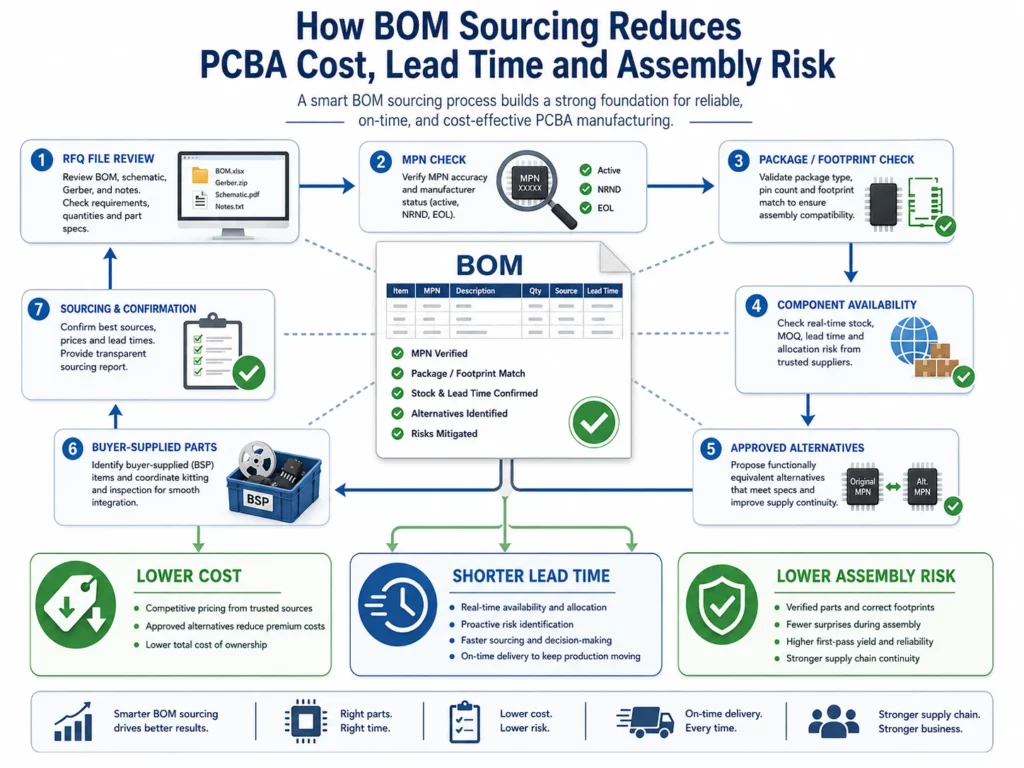
BOM sourcing for PCB assembly can decide whether a PCBA project moves smoothly into production or gets delayed by missing parts, wrong packages, unclear substitutes, or rising component costs. For OEM buyers, hardware engineers, equipment manufacturers, repair teams, and purchasing managers, the BOM is not just a parts list. It links design intent, component availability, assembly planning, cost control, testing requirements, and repeat production.
A complete and well-reviewed BOM helps a PCBA supplier identify sourcing risks before fabrication and assembly begin. It can reduce unnecessary quotation delays, prevent wrong component orders, and lower the chance of assembly rework caused by footprint mismatch, polarity errors, or unapproved substitutions.
Why BOM Sourcing Matters Before PCBA Production
Why a PCBA project can be delayed even when the PCB is ready
You can manufacture the bare PCB without problems, but the PCBA project can stall because a particular component is missing, outdated, incorrect, or not authorized for substitution. This often happens with OEM electronics, industrial control boards, communications modules, power electronics, and replacement PCBA projects that require specific ICs, connectors, sensors, or power components.
If BOM sourcing starts later, the assembly schedule depends on the slowest component, not the PCB production schedule. That is why a BOM review should occur before the final quotation whenever the project requires assembled boards rather than bare PCBs.
How BOM sourcing connects engineering, purchasing, and assembly
Engineering teams care about electrical performance, footprint compatibility, polarity, firmware behavior, and testing. Purchasing teams care about cost, availability, MOQ, approved suppliers, and delivery risk. Assembly teams care about package type, feeder suitability, component orientation, moisture sensitivity, and quantity overage.
BOM sourcing connects these concerns. If a BOM is incomplete, each department may make assumptions. Those assumptions can lead to incorrect components, delayed purchasing, production holds, or quality issues. For projects that require BOM review, PCB fabrication, and assembly planning in one workflow, a one-stop PCB manufacturing partner in China can help reduce supplier handoffs and unclear responsibilities.
Why component availability becomes the critical path
In many PCBA projects, component availability becomes the critical path. Long-lead components, single-source ICs, end-of-life parts, and unclear substitute rules can delay the whole build. This is especially important for repeat production, where one unavailable part can affect future batches even if the first order was successful.
Early BOM sourcing helps buyers identify these risks before committing to cost, lead time, and production quantity.
How BOM Sourcing Reduces PCBA Cost
BOM line items and unique part numbers
The number of BOM line items, the quantity of each component, and the number of unique part numbers influence PCBA cost. A design with many unique low-volume components may create higher sourcing overhead than a design using more standardized parts.
A BOM with clear manufacturer part numbers also helps suppliers quote more accurately. If a part is described only by value, such as “10k resistor” or “capacitor 10uF,” the supplier may need extra clarification before pricing or purchasing.
MOQ, packaging, and sourcing overhead
Component cost is not only the unit price. MOQ, packaging format, tape-and-reel requirements, cut tape handling, shipping, and supplier availability can all affect the final PCBA cost. Some components may be inexpensive individually but costly to source in small quantities because of minimum order requirements.
Early BOM sourcing and component procurement help buyers identify high-MOQ items, difficult sourcing conditions, and packaging issues before finalizing the PCBA quote.
Standard components vs special components
Standard resistors, capacitors, common connectors, and readily available ICs are typically easier to source than specialized parts. If specialized parts are required, they must be clearly specified so the buyer understands their impact on cost and lead time.
If possible, engineering groups could consider alternate specifications or packaging, but they must re-verify electrical requirements, mechanical fit, firmware compatibility, and the operating environment.
Approved alternatives and cost flexibility
Approved alternatives can give buyers more cost flexibility. For example, standard passive components may have several acceptable manufacturers, while a programmed MCU or certified module may require strict control.
The key is to define substitute rules before sourcing begins. Without approved alternatives, the supplier may have to stop purchasing and wait for customer approval. With clear alternatives, sourcing can move faster while still protecting the design requirements.
How BOM Sourcing Reduces PCBA Lead Time
Long-lead components
Long-lead-time components can delay PCBA assembly despite the PCB’s simplicity. Examples include certain ICs, sensors, connectors, power semiconductors, and modules. Identifying these components early makes it much easier to choose among waiting, approving an alternative, changing order quantities, and redesigning.
Obsolete or end-of-life components
Obsolete or end-of-life components create higher risk for repeat production. A part may be available for the first order but difficult to buy later. For OEM buyers, this can affect product continuity, maintenance programs, and replacement PCBA orders.
A sourcing review must flag parts with lifecycle concerns so the buyer can decide whether to approve an alternative or keep the component under strict control.
Single-source components
Single-source components may be required for performance or certification reasons, but they create supply chain risk. If one supplier cannot deliver, the entire PCBA order may be delayed. Buyers need to mark these parts clearly and decide whether they are no-substitute items or whether pre-approved alternatives are allowed.
Early BOM review before RFQ
Review the BOM before the final RFQ whenever possible. If the supplier receives Gerber files, BOM, CPL data, assembly drawings, testing requirements, and target quantity at the same time, sourcing and assembly risks can be reviewed together. This reduces repeated clarification and helps create a more realistic quotation.
How BOM Sourcing Reduces Assembly Risk
MPN errors and wrong component orders
Wrong or incomplete manufacturer part numbers can lead to incorrect component orders. A similar part number may have a different package, tolerance, voltage rating, temperature range, or pin configuration. These differences may not be visible until assembly or testing.
A reliable PCB assembly service needs to review the BOM together with Gerber files, CPL data, and assembly drawings before production, because BOM errors can create placement, soldering, and testing risks.
Package and footprint mismatch
A component can be electrically correct but mechanically wrong. If the package does not match the PCB footprint, SMT placement may fail, solder joints may be unreliable, or manual rework may be required. This risk is common when different package variants share similar part descriptions.
Footprint review is especially important for QFN, BGA, fine-pitch ICs, connectors, LEDs, diodes, and polarized components.
Polarity, value, and designator errors
BOM sourcing also depends on correct reference designators and values. If the BOM does not match the PCB layout or pick-and-place file, components may be placed in the wrong location or orientation. Polarity errors can affect diodes, LEDs, electrolytic capacitors, connectors, and some power components.
Buyers must keep the BOM, CPL file, and assembly drawing aligned under the same revision.
Substitute components without approval
Do not treat substitute components as simple replacements unless they meet the design requirements. Check a substitute for electrical performance, package compatibility, footprint fit, thermal behavior, availability, and testing impact. Some substitutes may also affect certification, firmware, or field reliability.
For critical parts, the BOM should clearly state “no substitute” or require written approval before purchase.
What Should Be Included in a PCB Assembly BOM?
Manufacturer part number and manufacturer name
A PCB assembly BOM should include the manufacturer part number and manufacturer name whenever possible. This reduces ambiguity and helps the supplier source the intended part instead of guessing from a generic description.
Reference designators and quantity per board
Reference designators show where each component belongs on the board. Quantity per board helps the supplier calculate purchasing quantity and required overage. Missing designators can create confusion between the BOM and placement file.
Package, footprint, and value
Package, footprint, and value help confirm that the selected component fits both the circuit requirement and the PCB layout. These fields are especially important for components with multiple package options.
Approved alternatives and no-substitute notes
Approved alternatives help sourcing continue if the preferred part is unavailable. No-substitute notes protect critical components that should not be changed without buyer approval. Both fields help reduce quotation delays and uncontrolled substitutions.
DNI / DNP parts and revision information
DNI or DNP parts should be clearly marked so the supplier knows which components do not need to be installed. BOM revision information is also important because PCB designs may change between prototype, pilot production, and repeat orders.
Full Turnkey BOM Sourcing vs Buyer-Supplied Components
When supplier-led BOM sourcing is useful
Supplier-led BOM sourcing is useful when the buyer wants one supplier to handle PCB fabrication, component sourcing, SMT/DIP assembly, inspection, and testing. This model can reduce communication work for overseas buyers or engineering teams without a local component sourcing channel.
When buyer-supplied critical components make sense
Buyer-supplied components make sense when the buyer controls critical ICs, programmed parts, certified modules, high-value components, or parts purchased under internal agreements. These parts should be clearly listed with designators, quantity, packaging format, and overage.
How to define approved alternatives before purchasing
Before purchasing begins, buyers should define which components allow alternatives and which do not. Review approved alternatives for electrical, mechanical, and assembly compatibility. For high-risk parts, the supplier must request buyer approval before substitution.
How to avoid responsibility gaps in partial sourcing
Partial sourcing can create responsibility gaps if the buyer and supplier do not clearly define who provides each component. A supplied component list should identify buyer-supplied parts, supplier-sourced parts, package type, quantity, label requirements, and expected delivery date.
How to Choose a PCBA Supplier with BOM Sourcing Capability
Check component sourcing channels and BOM review process
A qualified supplier should review the BOM before purchasing and identify missing MPNs, unavailable parts, package mismatch, long-lead components, and substitution risks. Buyers should ask how the supplier handles unclear part descriptions and how sourcing questions are communicated during RFQ review.
Check substitute approval and incoming inspection rules
Substitute approval should be controlled. A supplier should not replace critical components without buyer confirmation. Check incoming inspection rules, especially for customer-supplied parts, sensitive components, or components with special storage requirements.
Check SMT/DIP assembly and PCBA testing support.
BOM sourcing should connect directly to assembly capability. The supplier needs to understand whether the design requires SMT assembly, through-hole assembly, mixed assembly, AOI, X-ray, ICT, flying probe, functional testing, firmware loading, or special handling. The exact testing plan depends on the product application and buyer-provided procedures.
Why UMEC fits BOM sourcing and turnkey PCBA projects
UMEC’s confirmed service chain covers PCB fabrication, component sourcing, PCB assembly, and PCBA testing for custom electronics projects. This makes UMEC relevant for buyers who need BOM sourcing support before PCBA production, whether the project uses supplier-led sourcing or buyer-supplied critical components.
For projects that require different board technologies before assembly, buyers can also review UMEC’s PCB product matrix for PCB categories such as HDI, multilayer, rigid-flex, flexible, RF, heavy copper, and ceramic PCBs.
RFQ Checklist for BOM Sourcing and PCBA Assembly
Gerber files and PCB specifications
Submit Gerber files with PCB specifications such as layer count, material requirements, copper thickness, board thickness, surface finish, solder mask, and target quantity. State any special application conditions clearly.
BOM with MPNs and substitute rules
The BOM should include MPNs, manufacturer names, designators, package, quantity, approved alternatives, no-substitute notes, and revision information.
CPL / pick-and-place file
The CPL, or pick-and-place file, provides component coordinates, rotation, and side-of-board information for SMT assembly. It should match the BOM and PCB design revision.
Assembly drawing and polarity notes
Assembly drawings should show polarity, connector orientation, special soldering notes, mechanical constraints, and any components requiring manual handling.
Testing requirements and target quantity
Buyers should specify testing requirements, target quantity, shipping destination, packaging needs, and expected repeat-order plans. If functional testing is needed, discuss test procedures, firmware, fixtures, and acceptance criteria before quoting.
Conclusion
BOM sourcing can lower PCBA costs, shorten lead times, and reduce PCBA risks by identifying component issues before production. A well-prepared BOM helps buyers manage sourcing responsibility, reduce lead-time risks, and avoid ordering incorrect parts and potential rework due to incorrect packaging or substitutes.
When submitting a PCBA quote request, buyers have to get ready with the following information: Gerber files, BOM with MPN numbers, CPL details, assembly drawings, substitution guidelines, testing specifications, required quantity of the product, application description, and samples/failure images if replacement/troubleshooting is involved in the project. UMEC can review all provided information for PCB fabrication, component sourcing, PCB assembly, and PCBA testing needs.
FAQs
Q1: How does BOM sourcing reduce PCBA cost?
A: BOM sourcing can reduce PCBA cost by identifying high-MOQ parts, unavailable components, special packages, and approved alternatives before quotation. It also helps prevent wrong purchases and rework, which can increase the total project cost.
Q2: Why does component availability affect PCB assembly lead time?
A: Component availability affects PCB assembly lead time because one missing, obsolete, or long-lead part can stop the entire PCBA build. Early BOM review helps buyers find sourcing risks before production scheduling begins.
Q3: What should be included in a PCB assembly BOM?
A: A PCB assembly BOM should include manufacturer part numbers, manufacturer names, reference designators, quantity per board, package, footprint, value, approved alternatives, no-substitute notes, DNI/DNP marks, and revision information.
Q4: Can substitute components be used in PCBA production?
A: Substitute components can be used only when they match the electrical, mechanical, footprint, assembly, and testing requirements of the design. Critical parts should require buyer approval before substitution.
Q5: Should OEM buyers choose full turnkey BOM sourcing or supply components themselves?
A: OEM buyers may choose full turnkey BOM sourcing when they want the supplier to manage components and assembly together. Buyer-supplied components may be better when critical ICs, certified parts, programmed devices, or approved supply channels must remain under buyer control.